When a Republic Begins to Drift
There are moments in public life when words feel insufficient. Watching the actions of Senate leadership during Wyoming’s 2026 legislative session was one of those moments. Even the word “speechless” does not quite capture it.
But history has a way of restoring clarity when the present becomes confusing. In moments like this, my mind often turns to the past… to the extraordinary debates that gave birth to the American republic. We are fortunate that the men who built this nation left us something rare in human history, a written record explaining not only what they built, but why they built it. Those explanations became The Federalist Papers.
Within those pages is a standard for our republic and the role of democracy within our government. An ominous stage was set this year, and it should give every citizen pause when we compare our founding to what unfolded inside Wyoming’s Senate chamber this year. Because what we witnessed was not merely political disagreement. It was something far more troubling.
The Standard the Founders Set
The men who wrote The Federalist Papers believed something radical for their time, that a free people could govern themselves. But only if the government remained accountable, transparent, and restrained by principle rather than convenience. They understood that power naturally seeks to expand. That ambition must be checked, and public institutions must remain accountable to the people they serve.
The American system was built around those truths, but systems alone cannot preserve liberty. An individual's moral character must be the cornerstone of every action and motive. When it is not, that is where the warnings begin to sound. We saw far too many warnings take place on the senate floor to turn a blind eye any longer.
John Adams' words echoed in my mind as I watched the weeks unfold. “Our Constitution was made only for a moral and religious people. It is wholly inadequate to the government of any other.”
What Happened in the Wyoming Senate
What unfolded during this legislative session was not the deliberative, transparent process the founders envisioned. Instead of open debate, there were closed-door caucuses. There was a lack of rigorous discussion on the Senate floor. There were delays, recesses, and early adjournments.
Instead of allowing the legislative process to work through disagreement, bills that represented the will of Wyoming citizens were quietly stalled, weakened, or allowed to die through procedural maneuvering. The excuses offered were time constraints, but the clock was not the problem. Time did not run out; time was altered and manipulated. Senate leadership simply chose not to use it ethically.
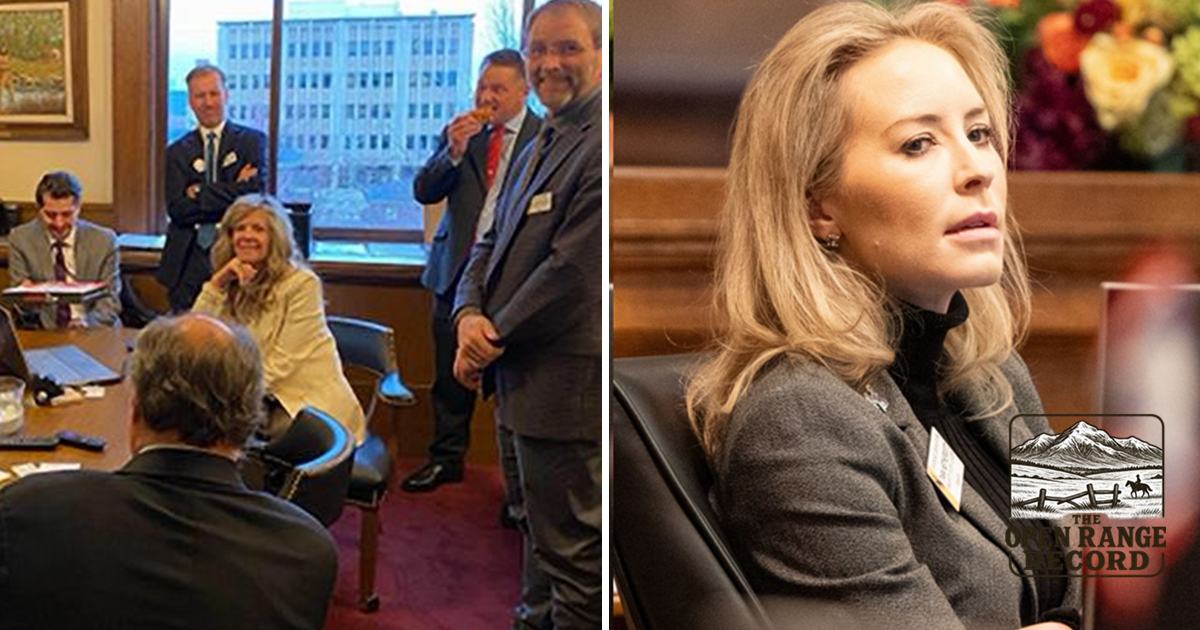
The actions of Senator Nethercott were completely lacking in virtue. Through her Machiavellian maneuvers, a sinister smile was displayed each and every time. She and her leadership counterparts delayed, detoured, and distorted intention. This is not the behavior of moral character. When what occurred is viewed in its entirety, the picture they were painting in words is too thin.
What Wyoming citizens witnessed was not the natural friction of a functioning legislature. It was the deliberate narrowing of debate. Even more troubling was the tone that crept into our governing institutions. Legislators were even publicly targeted before investigations were complete. Members of the House saw their integrity questioned before facts were known. Accusations traveled faster than truth, and the seriousness of the institution itself began to erode under the weight of political maneuvering.
The senate leadership continued to ignite unnecessary fires in an attempt to keep citizens looking in another direction. That is not strength and honor. It is decay and deceit.
A Reminder of What Was Built
In a world long dominated by kings, empires, and inherited power, a group of determined thinkers dared to ask a radical question: Can man govern himself? Their answer was breathtaking. Instead of building a nation around a ruler, they built one around principles, liberty, self-government, and the inherent dignity of the human person to pursue happiness.
Three great works came to define that achievement. One, The Declaration of Independence proclaimed that human beings possess God-given rights that no government may rightfully take away. Second, the United States Constitution established the structure designed to protect those rights. Last, is a work that is too often left to collect dust but is no less important. It is a compilation of writings that explain why the structure existed and how it would safeguard liberty. That work is The Federalist Papers.
Written when the Constitution itself hung in the balance, these essays revealed the intellectual brilliance and moral seriousness behind the American experiment in freedom. They explained not only how the system worked, but also why it mattered.
The Wisdom Behind the Structure
The authors of The Federalist Papers drew upon centuries of philosophical and historical understanding. Their writings reflected ideas shaped by Scripture and by thinkers such as John Locke, Montesquieu, David Hume, and others who grappled with liberty and human nature.
From those traditions they recognized a fundamental truth; human beings are capable of both virtue and ambition. Because of this, liberty cannot depend solely on the goodness of those in power. The Constitution therefore divides authority among branches of government and between the federal government and the states. Each part of the system checks the others so that no single force can dominate.
It is a structure of remarkable elegance, one that channels human ambition into the protection of liberty itself. Yet even this brilliantly designed system has limits. Those limits were tested repeatedly in the 20 days of this year’s budget session.
The Senate Leadership used procedural control to stifle the will of the people. Their actions did not just affect their chamber alone. They created fissures throughout the foundation inside the Capitol walls.
The founders understood that a republic ultimately depends on the character of its people and its leaders. John Adams expressed this truth plainly, “Our Constitution was made only for a moral and religious people. It is wholly inadequate to the government of any other.”
Adams was not speaking about outward displays of religiosity. He was speaking about moral restraint, the understanding that those who hold power must exercise it with humility and responsibility. When that restraint fractures, the process begins to strain. Citizens witnessed and felt leadership prioritizing control over transparency, and in turn the people's confidence in the institution itself is eroding.
The Responsibility of Representation
For those entrusted with public office, this principle carries enormous weight. A representative in a republic is not meant to serve government itself or powerful institutional interests. The duty of public office is to represent the people faithfully and to preserve the constitutional structure that protects their liberty.
Authority in a republic is not ownership of power; it is stewardship. Those who hold office are not masters of the republic; they are servants of it. Wyoming’s legislature was intentionally designed as a citizen legislature. It is not meant to be a permanent political class or a career detached from the people.
Serving the State of Wyoming is part-time by design, an arrangement intended to remind those elected that they are citizens first and lawmakers second. A citizen legislature functions only when citizens' voices are allowed to be heard openly and debated honestly. We saw far too often in the Senate Judiciary committees especially, that bills brought by the people were mocked and belittled. It seems the people are too uneducated to understand the legal system and only educated lawyers can determine and decipher laws.
When bills supported by citizens are stalled while institutional priorities are moved and protected, there is a growing concern in our state. Citizens can't help but question whether their legislators are serving them or managing the system around them.
The Beauty—and Fragility—of the Republic
What the founders created is one of the most extraordinary achievements in human history, a system designed to balance liberty and order, ambition and restraint, power and accountability. The Constitution and The Federalist Papers together form a blueprint for freedom unlike anything the world had seen before. But the founders also understood something sobering.
A republic is not sustained by parchment alone. It must be sustained by action, by virtue, and by leaders willing to place principle above convenience. That is why moments like the ones Wyoming witnessed these last few months in the legislative session carry such weight. The health of a republic is not measured only by the laws that pass, but by the integrity of the process used to pass or prevent them.
The warning signs the founders wrote about have begun to appear. Our republic will not collapse in a single dramatic moment. It has begun to drift like a ship whose helm has been left unattended, slowly slipping off course until it no longer recognizes the waters it sails in.
In Reflection
I ask you to pause. Ponder what you witnessed during this legislative session. Reflect not only on the votes that were taken, but on the debates that were never allowed to happen. Reflect not only on the bills that passed, but on the bills that quietly disappeared through procedural delay; bills with catch titles showing one thing, while the content showed a very different intent.
The American republic was not built on convenience; it was built on courage. The courage to debate openly. True courage allows for disagreement. Genuine courage trusts the people with the truth and to be a part of the process.
Our founders disagreed fiercely with one another. The Federalist Papers themselves were born out of those disagreements. Yet those debates were conducted in the open, where citizens could see the reasoning behind the decisions being made. That transparency is what gives a republic legitimacy. When transparency fades, trust begins to fade with it.
A Final Warning
What Senate leadership did during the 2026 legislative session cannot continue. This process cannot become the norm. The founders warned that our republic wouldn't collapse in a sudden, dramatic moment. If it happens, it will erode slowly through small deviations from principle that gradually become accepted practice. If we normalize what we witnessed this session, we will be normalizing the very erosion they feared.
The authors of The Federalist Papers understood something many modern leaders seem to forget. The Constitution can restrain power, but it cannot replace character. A republic survives only as long as those entrusted with authority remember that they are stewards of the people’s trust, not managers of political outcomes.
The real danger to Wyoming’s republic is not disagreement, debate, or even political defeat. The real danger is when leadership begins to believe the process itself belongs to them. Because the moment power stops serving the people and begins protecting itself is the moment a republic begins to lose the very soul that gave it life.