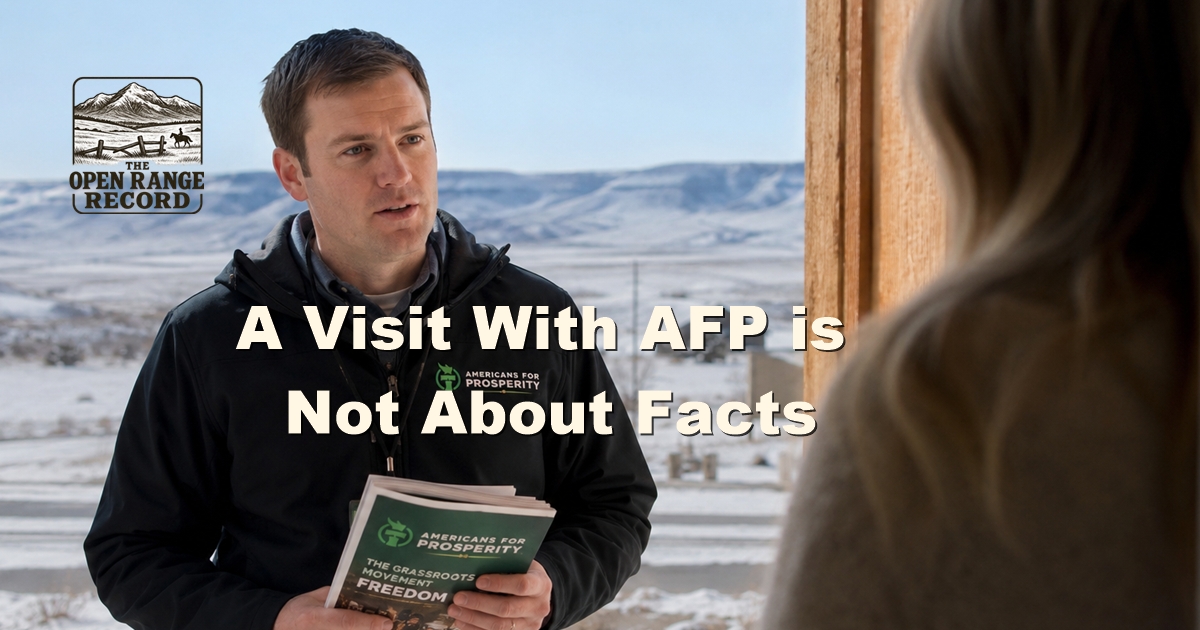
Over the Fourth of July weekend, there was a knock on my door.
A young man introduced himself. I am choosing to leave out his name, because this isn’t about him. It’s much bigger. “My name’s _____ . I’m just in the neighborhood checking to see who’s going to be voting in the GOP primary that’s coming up.”
I noticed the yellow Americans for Prosperity campaign shirt he was wearing and the bag on his shoulder. I asked who he was walking for.
“We’re walking for Tony Niemiec, actually.”
I asked why AFP chose Tony Niemiec over Marlene Brady. He tried to pull up the information on his phone but couldn’t find it. Instead, he explained that he wasn’t actually from Green River.
We continued talking. It wasn’t heated or argumentative—just two people having a conversation. He was kind and eager to engage.
As our conversation continued I asked him if he was getting paid to walk.
Me: “So you get paid to walk, right?”
AFP : “Yes.”
There’s nothing wrong with getting paid to do a job. We all have bills to pay. Then I asked him another question. “Do you support the candidates that you walk for, or are you unbiased?” His answer caught my attention.
AFP: “I’m a bit of an outsider in this regard, so I’m unbiased. I favor whoever is, you know, pro-small government…”
Then the question that really sparked the rest of our conversation: “Did you know Marlene Brady is pro small government?”
He replied, “yeah she is running as a GOP, I kinda assumed that came with the territory,”
So I asked another question. “Did Tony make his talking points for you, or are they created by AFP?” His answer surprised me.
“I’ll be honest, I haven’t actually asked my boss.”
Me: “So, you don’t know where you get your information from?”
AFP: “Admittedly, no.”
That was the moment the conversation changed for me. This wasn’t a young man trying to mislead me. He wasn’t rude or argumentative. He was simply being honest. Then he said something that made me want to help him: “You know what, you're actually more informed than I am, so I’m not going to give you the persuasion script.”
I asked him why AFP supported Tony over Marlene and he again did not have an answer. So, I explained why I had concerns. I told him that I disagreed with the inaccurate claims being made about Representative Marlene Brady, and I encouraged him not to take my word for any of it. I told him to go look for himself.
Read the bills. Read the voting records. Compare what candidates say with how they actually vote. Look at legislative scorecards. Don’t rely on headlines or campaign mailers and do your own homework.
His response was immediate. “Definitely, I should probably try and do some research myself.”
That wasn’t the answer of someone who thought he knew everything. Then came the statement that has stayed with me ever since.
“I’ll be totally honest. I don’t really know much about either candidate.”
A young man was being paid to knock on doors and influence voters, yet by his own admission, he didn’t really know much about either candidate in the race.
I don’t write that to criticize this young man. I actually respect him. He could have pretended he knew the answers and just repeated talking points. Instead, he admitted what he didn’t know.
That kind of honesty is refreshing.
What bothered me wasn’t this young man at my front porch. It was what his answers made me think about. In almost every profession, we expect people to know what they’re doing before we ask them to represent someone else. If I need electrical work done, I’m going to hire an electrician who understands electrical systems. I’m not going to hand someone a pair of wire cutters and hope they figure it out.
If I go to the hospital, I expect my nurse to understand medicine. I don’t want someone learning the basics while they’re standing at my bedside. If I hire a mechanic, I expect them to know how to repair my truck.
So why would we expect any less from people who are sent into our neighborhoods to influence elections? When someone knocks on your door representing a candidate or an organization, most people naturally assume that person understands the candidate’s record, the issues, and where their information comes from.
As our conversation continued, I told him something I believe regardless of the candidate or political party.
“If you’re going to support somebody, then you should know who they are.”
Then I asked him something I hope he remembers long after this election is over:
“At the end of the day, is it about money or is it about integrity?”
I wasn’t trying to embarrass him. In fact, I told him more than once that I was trying to help him and not make him feel bad. I wanted him to understand that this wasn’t about winning an argument. It was about encouraging him to think for himself.
As we talked about property taxes, government spending, the Wyoming Constitution, and the role of state government, he paused and said something else that caught my attention: “That actually does sound like something I’d support.”
That told me he wasn’t closed-minded. He was willing to listen, learn and willing to consider information he hadn’t heard before.
Before he left, he thanked me:
“Thank you for actually having a conversation with me about it.”
That statement has stuck with me. This article isn’t about this young man but about the responsibility that comes with asking someone to represent your message. He then said something that made me even more concerned.
He said, “I’m beginning to see why I got the job so easily, something seemed too good.”
That statement should make everyone pause. If an organization believes strongly enough in a candidate to spend money sending people door-to-door, then it should believe strongly enough to prepare those people before they ever knock on the first door--teach them the candidate’s record; teach them the issues and where the information they’re sharing comes from.
Perhaps more important, this young man should have been taught how to answer honest questions. He shouldn’t have been handed campaign literature, a walking list, and a script on his phone to just type in the question and it populates.
More importantly, he should have been encouraged to think for himself.
One of the things I appreciated most about this young man was that he was willing to say, “I don’t know.” In today’s political climate, that’s rare.
The young people hired to represent political organizations deserve better than being sent into neighborhoods without the preparation they need to succeed.
Our republic depends on informed voters and it depends on informed advocates. No matter what candidate you support, no one should ask another person to carry their message until they first understand it.
Why is AFP going after candidates who are in office so hard with false information? This man agreed with everything Marlene Brady had done over her last two years in office. He didn’t want Wyoming to end up like California. That is one reason he told me he moved here.
Perhaps the best question to ask is, why was this young man so misled by Americans for Prosperity and then sent to my doorstep? We can only speculate what all the true motivations are; on one we can be certain: it’s definitely not about the truth.