NEWS
One challenger left the race and went to work for the sheriff. Another stayed in the race and is now on paid administrative leave.
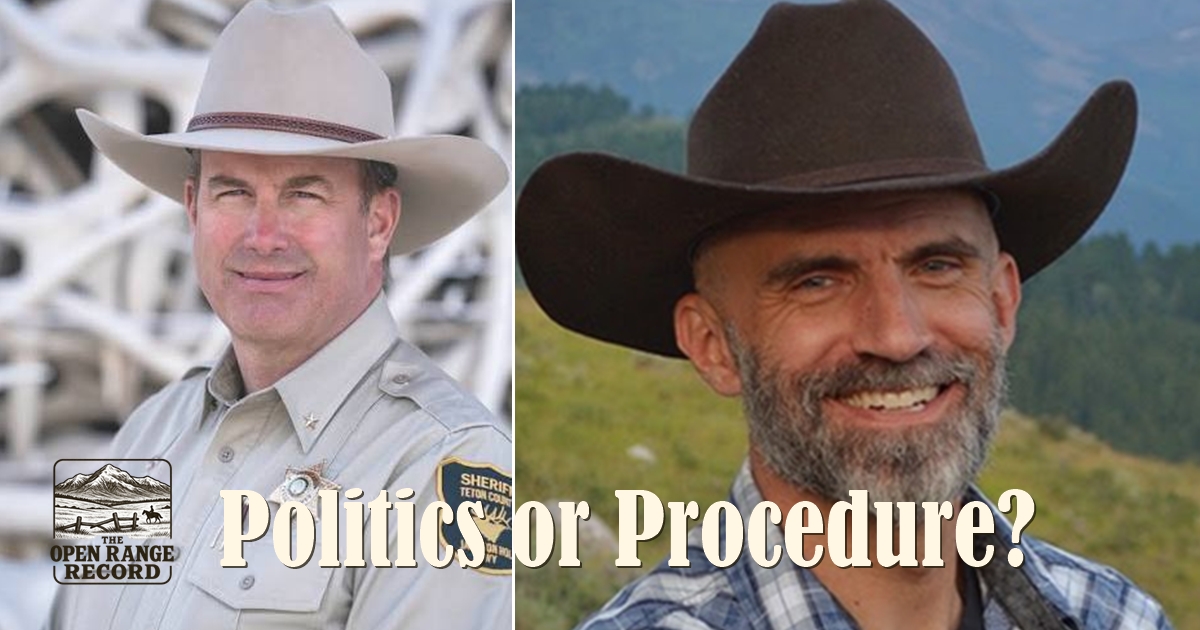
That is where Teton County’s sheriff’s election stands as voters prepare to choose among Democratic incumbent Matt Carr, Republican Deputy Eric Snow, and independent Chris Glenn on November 3.
Getting here took more than one disputed traffic stop. Carr entered this election with an immigration record that had already drawn federal criticism and a major policy reversal. Then came employment discussions with his Democratic primary opponent, an FBI referral involving his Republican opponent, a disputed request concerning that deputy’s professional credentials and, finally, administrative leave.
Deputy Snow says the department has used its authority to damage his candidacy. Carr denies weaponizing the office and says he did not decide to place Snow on leave. Their competing accounts leave voters with a question that reaches beyond campaign slogans: How were these decisions made, and what records support them?
The immigration reversal
In February 2023, Carr told ICE his office would require a judge’s signature to hold noncitizens, according to an agency statement reported by Cowboy State Daily. ICE also said the office was withdrawing from a detention agreement; Carr later said he did not recall canceling it. By November 2024, 103 of 118 detainers had gone un-honored. Carr confirmed those figures, citing constitutional and liability concerns. His office still shared booking information and facilitated ICE interviews.
A December 2024 internal email reported by the JHN&G acknowledged that release notifications had become less of a priority when staff believed ICE agents were not committed to pickups. Deputies were instructed to give more notice, but Carr said he did not plan to change his detainer policy.
On March 5, 2025, he reversed course: the jail would honor civil ICE detainers for up to 48 additional hours without a judge’s signature. Carr credited discussions with ICE and Wyoming sheriffs about procedures and legality for the change. This followed criticism from Rep. Harriet Hageman, Trump’s return to office, and state lawmakers’ push against sanctuary policies.
What changed: the legal advice, the federal arrangements, or Carr’s judgment under political pressure? The reversal came about 20 months before this election.
By late October, Carr said ICE had collected 225 people from the jail since March 2025. A county-funded assessment of immigration practices will not deliver its findings until after the election.
A challenger becomes an employee
Immigration was already a campaign issue when Jackson police officer Alberto Rojas entered the Democratic primary against Carr. Rojas initially expressed agreement with Carr’s current immigration approach.
Rojas withdrew on May 29, the day candidate filing closed. He later took a job Carr had offered while Rojas was still a candidate, according to KHOL.
The recruitment drew objections at a county budget meeting. Carr denied explicitly offering employment to secure Rojas’s withdrawal. He said the Spanish-speaking officer could improve relationships with the immigrant community and assist with an assessment of the department’s practices.
Snow’s October 27 campaign release casts that hiring differently, describing it as a way to remove a political opponent.
The opponent who stayed in the race
Snow continued campaigning while working patrol. On July 18, he arrested Ethan McIntyre on suspicion of drug-impaired driving. The DUI charge was dismissed, and subsequent reporting described an evaluation finding no evidence of impairment.
The Sheriff’s Office referred the arrest to the Wyoming Division of Criminal Investigation, which referred it to the FBI as a potential civil-rights matter. The FBI declined the case because it did not meet its threshold for a federal civil rights violation. On October 26, East Idaho News reported that the Wyoming Highway Patrol confirmed its personnel review was ongoing and noncriminal.
Snow maintains that the arrest was justified. His October 27 campaign release alleges that the department refused additional blood testing for substances beyond the standard panel and did not respond to his request to preserve the sample. Carr has told KHOL that the blood was preserved and extensively tested.
Snow also alleges that officials publicized the referral to generate damaging campaign coverage and failed to promptly correct the public impression after the FBI declined it.
The FBI’s decision does not settle every question about the arrest. Nor does the appearance of a newspaper story establish who initiated the publicity or why. The timing of the referral, the communications with reporters and the notification of the FBI’s decision are among the records needed to assess Snow’s accusation.
A call about Snow’s credentials
The September Drug Recognition Expert call concerned July’s McIntyre arrest and preceded the woman’s October arrest. Snow’s October 27 campaign release alleges that Lieutenant Priest, who eventually placed Snow on suspension, sought his decertification as a DRE and wanted the state to handle it so it “doesn’t look like election interference.” That is Snow’s account.
When Snow’s attorney returned The Open Range Record’s call, the question was specific: Was there paperwork documenting the DRE request? The attorney said there was no physical paper request; the communication had occurred by telephone. Snow had not initiated the conversation, according to the account provided to The Open Range Record.
KHOL’s October 27 report, says the county supplied a September 21 recording of Priest speaking with Lieutenant Evan Storch, a Laramie County officer who runs the state’s DRE training. KHOL describes a request to pause Snow’s evaluations until after the election or resolution of the July case, rather than outright decertification. Storch told KHOL the case provided no basis to decertify Snow and questioned the timing.
The Open Range Record has not independently reviewed the recording. The attorney’s account of a telephone request does not establish that no other records exist. Why did Priest reportedly tie a pause in Snow’s DRE evaluations to the end of the election? What would Election Day change about his professional qualifications?
Thirteen days before Election Day
On October 21, Snow was placed on paid administrative leave.
The action followed a traffic stop involving a woman reportedly driving 74 mph in a 50-mph zone. According to court records described by KHOL, a portable breath test registered 0.202%. Snow arrested her for violating release conditions from an earlier DUI case but did not complete a new DUI investigation. Priest said he made the leave decision, while Carr said the election had removed him from the decision-making process.
Snow’s campaign release says the department cited a “Fail to Act” policy. He disputes that description: he stopped the vehicle, investigated a release-order violation, and arrested the driver. He says he chose that charge because he considered it the stronger legal foundation.
Priest says the office reviews every deputy’s work. Carr offered to release Snow’s personnel file with his consent; Snow declined, citing privacy. Snow’s attorney disputed Carr’s characterization of a concerning pattern in his work.
Comparable disciplinary records and documentation of Carr’s recusal could help test those competing accounts.
Who answered and what remains unanswered
Carr’s campaign emphasizes experience, support for deputies, and public trust. Snow promises enforcement without political bias and more direct communication with residents.
The Open Range Record emailed questions to the Sheriff’s Office seeking responses from Carr and Priest about Rojas’s hiring, the DRE communication, investigative referrals, evidence preservation and Carr’s recusal. The inquiry set a 3 p.m. Mountain Time deadline on October 28. As of this report, the office had not provided an email response.
Snow’s attorney returned a call and addressed the question about DRE documentation. That conversation was limited to that subject; it was not a point-by-point response to every issue in this article. Carr’s and Priest’s explanations in previously published reporting are included above.
Author’s opinion
Snow deserves to have his explanation heard before voters are asked to treat administrative leave as a verdict on his fitness for office. His attorney returned this publication’s call. That willingness to engage deserves acknowledgment, even though it does not settle the disputed arrests.
The larger questions remain. Did the job offered to Rojas help clear Carr’s path through the Democratic primary? Did the scrutiny of Snow after July, the DRE intervention, and the October leave decision serve legitimate supervisory purposes, weaken a Republican challenger’s credibility, or both? The sequence warrants answers. It does not, by itself, prove a deal with Rojas or a coordinated campaign against Snow.
Carr says he had no role in placing Snow on leave. However, having a lieutenant within his own chain of command make that decision leaves a fair question about the safeguards separating personnel decisions from the sheriff’s political interests. In the mob, The Don always has his lieutenants handle the dirty work. The separate Highway Patrol review is relevant, but it does not explain every internal decision. Voters deserve to know how the recusal worked and whether comparable conduct by other deputies received comparable treatment.
In this author’s humble opinion, the election-linked DRE request, followed by administrative leave less than two weeks before voting, creates the appearance of a political hit job. Why should voters accept assurances of fair treatment without an explanation of that election connection? The Sheriff’s Office has not answered this publication’s emailed questions. That silence does not prove hidden wrongdoing or political intent, but it leaves a troubling sequence without a direct explanation here.
Teton County voters should not have to choose between campaign accusations and assurances from inside the department. They deserve the records and a clear explanation of who made these decisions and why. Their decision comes November 3.