NEWS
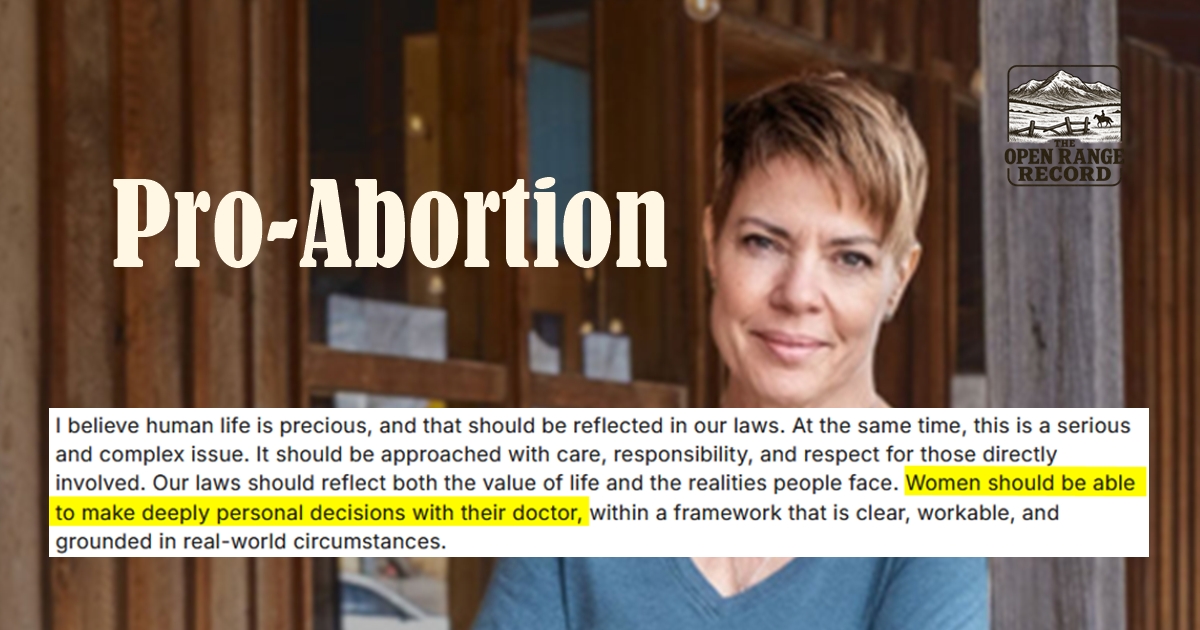
Melissa Butcher is running as a conservative Republican for Wyoming Senate District 21, but her own campaign website reveals a position on abortion that is fundamentally at odds with the Wyoming Republican Party Platform. Under the “Values and Constitutional Rights” section of her website, Butcher begins with language that sounds cautiously pro-life. She writes that “human life is precious” and says that principle should be reflected in Wyoming law.
But she then adopts the central argument of the abortion-rights movement: “Women should be able to make deeply personal decisions with their doctor.”
That is not a pro-life position. It is the familiar “woman and her doctor” formulation used to argue that the government should not prevent an elective abortion. Although Butcher surrounds the statement with vague references to “care,” “responsibility,” and a “workable” legal framework, she never says that an unborn child possesses a right to life that the law must protect.

Instead, her position leaves the decision to end that child’s life with the mother and an abortion provider. Whatever softer terminology may be used, that is a pro-elective abortion position.
The Open Range Record contacted Melissa Butcher by text for comment. She did not respond by the 12:00 deadline given.
A Direct Contradiction with the Republican Platform
The contradiction with the Wyoming Republican Party Platform could hardly be clearer. The platform’s first plank states:
“All individuals are endowed by their Creator from the moment of conception to the moment of natural death with the rights to Life, Liberty, Property, and the Pursuit of Happiness. The only purpose of government is to protect these rights for all.”
The platform does not say that the right to life begins when a doctor agrees. It does not say that an unborn child’s rights depend upon whether his or her mother wishes to continue the pregnancy. It recognizes the right to life from the moment of conception and declares that government has an obligation to protect that right.
Butcher says government should allow a woman and her doctor to make the decision. The Republican platform says government must protect the unborn child’s life. It is impossible to reconcile those two positions.
Butcher also claims on her campaign website that government’s essential responsibilities include protecting rights. Yet, when addressing abortion, she declines to recognize or protect the most fundamental right belonging to the unborn child—the right to remain alive.
A Stark Contrast with Ken Pendergraft

The distinction between Butcher and Rep. Ken Pendergraft is especially important because voters are not being asked to choose between two candidates who merely differ in style. They are choosing between fundamentally different approaches to the right to life.
Pendergraft has a legislative record that is not carefully crafted campaign language. Representative Pendergraft has supported every piece of pro-life legislation that has come before him, including Wyoming’s 2026 heartbeat law, which prohibited abortions after a detectable heartbeat.
Pendergraft is endorsed by Wyoming Right to Life. Butcher is not. When asked for a comment on this story, Pendergraft said, “We must protect life from conception until natural death—no abortions, no exceptions and no ‘end of life counseling.’”
Butcher, on the other hand, couches her position in careful political rhetoric: the decision should remain with a woman and her doctor. Pendergraft offers voters a documented record of supporting legal protection for unborn children. The contrast is beyond stark.
Voters Deserve Plain Language
Political candidates often attempt to avoid the word “abortion.” Instead, they talk about “complex decisions,” “real-world circumstances,” “personal healthcare,” and conversations between women and doctors. That is exactly what appears on Butcher’s website.
Changing the vocabulary does not change the act being discussed. The “deeply personal decision” described on Butcher’s website is the decision to end the life of an unborn child.
Butcher is entitled to hold that position, but Republican voters are equally entitled to know that it conflicts directly with their party’s platform. A candidate should not be permitted to claim the conservative label while quietly adopting the abortion lobby’s fundamental argument.
The choice in Senate District 21 is strikingly clear. Melissa Butcher is in favor of elective abortions. Ken Pendergraft’s record is defending the unborn.