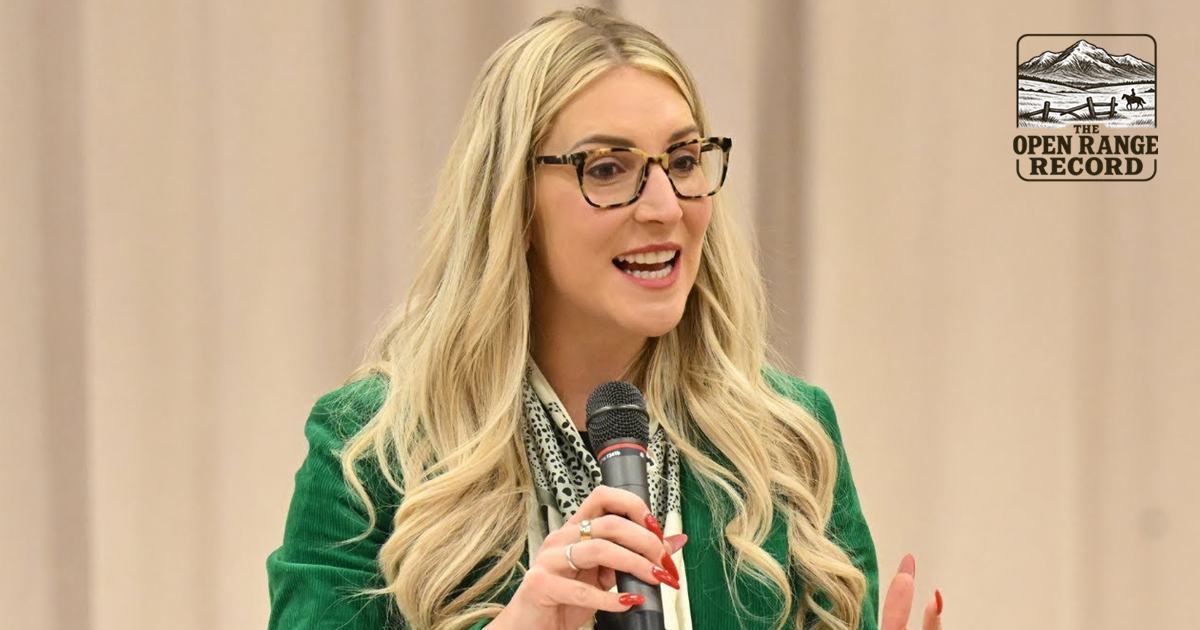
A group of the Wyoming Federation of Republican Women sat down with Superintendent of Public Instruction Megan Degenfelder last week for a Q & A session about education.
Several women asked what Degenfelder thinks about all the student anti-ICE walkouts happening around the state. She referred to her public statement:
“All Americans, including young Americans, have constitutionally protected rights to peacefully express their views. At the same time, our schools’ primary mission is to educate and keep students safe. The LCSD #1 Superintendent and local school district officials did the right thing by marking participants absent in accordance with the attendance policy and reinforcing that school staff may not engage in political organizing in their official roles. I stand firmly with the men and women of Immigration and Customs Enforcement and all law enforcement officers who put their lives on the line to uphold our laws and keep our communities safe. I also remind our students that the best way to honor the freedoms we enjoy in this country is by getting an education and becoming informed, responsible citizens.”
While she spoke with individual school administrators, she admitted that statute prevents her from doing anything else – it’s up to the school boards to decide on any consequences (W.S.21-4-308(a) and W.S. 21-4-305).
When asked what she was doing to make sure accurate history, civics and patriotism is being taught in schools, she said she has added great curriculum to the portal and informed districts that it is available for them to use, but Wyoming law (W.S. 21-3-110(a)(i)) gives the authority to choose curriculum to school boards, not the Superintendent of Public Instruction. In fact, the State Board of Education is explicitly forbidden from prescribing specific textbooks or curriculum (W.S. 21-2-304). Sadly, most school boards seem to be going along with whatever the school administrators want.
A parent brought up SEL (Social Emotional Learning) and how it is negatively impacting kids and learning and asked if the superintendent could ban it from being used in Wyoming schools.
Megan agreed that it is not a good thing, and she would like to see it removed, but again, her office doesn’t have the authority to choose what is taught in schools. She said she was shocked when she first took office and discovered just how much authority she DOESN’T have as superintendent.
This was when the topic turned to her run for governor and where she stands on traditional Wyoming ideals:
She said her background is in coal, and she plans to focus on coal, oil, and gas, and making sure Wyoming is a national leader in energy production. She is not opposed to nuclear energy, but she doesn’t want Wyoming to become the nation’s nuclear waste dumping ground.
The next question brought the focus back to education: why does she want to move from superintendent to the governor’s office?
She said that she is frustrated by the constraints placed on her as superintendent and the inability to make real change in education – in the curriculum.
The subject of AI was introduced, and how quickly it is advancing. Today’s students will graduate ill-equipped to step into the rapidly changing job market AI is creating. What can be done to ensure that Wyoming students are prepared to succeed in this environment?
Megan shared her vision of a different learning model: half of the day spent on traditional subjects and the other half focused on career and technical training, trades instruction, and spending time out of the classroom in hands-on learning. The goal would be for students to graduate with both a diploma and a certificate in a trade or technical expertise. This would include learning to use AI effectively but would focus on “learning to learn” rather than relying on AI to supply answers.
The Catch-22 seems to be that she has a great vision for bringing education into the future where students can graduate ready to either move right into a trade or technical specialty or to university for those careers that require a degree, but the Superintendent of Public Instruction has been restricted from being able to make it happen.
Would she be able to guide education from the governor’s office? Not according to current statute.