This was an old commercial for recording on Memorex cassette tapes. Apparently, it was so clear compared to other technology that you couldn’t tell if you were hearing it live or on a recording. While that was many years ago and technology has certainly evolved past cassettes, the newest question has become whether it is real or is it AI?
Artificial intelligence (AI) is a branch of computer science that simulates human intelligence to perform tasks like learning, reasoning, problem-solving, perception, and decision-making. It works by analyzing vast datasets, identifying patterns, and using algorithms, specifically machine learning and deep learning, to improve performance without explicit programming.
In the 2026 Wyoming Budget session, legislators are grappled with a few bills dealing with the (AI) subject.
· HB0091 – Ban on Government Social Scoring with AI. Yin
· HB0102 – Protecting Kids from Deepfakes and Exploitative Images. Lein
The intention of HB91 brought by Rep. Yin is to prohibit government entities from using artificial intelligence to calculate and assign social scores; and prohibit government entities from using artificial intelligence (AI) to identify persons using biometric data or gathering of images.
An Amendment notes that the bill “does not apply to the development, deployment or use of an artificial intelligence system by any Wyoming law enforcement agency for the purpose of preventing, detecting, protecting against or responding to security threats, identity theft, fraud, harassment or any other violations of Wyoming criminal code.”
HB0091 was not considered for introduction this session.
HB0102, brought by Rep. Lien, specifies that using intelligence (AI) to commit a criminal offense shall not be a defense; establishing criminal offenses concerning the use of synthetic sexual material or (AI) generated materials against children. It would also establish criminal offenses concerning the use of (AI) to promote self-harm or to censor political speech while providing immunity for the developer or (AI) systems.
While the HB91 “Ban on government social scoring” died in the House, HB102 had great support in the House and Senate and is now on its way to the Governor.
In 2024, SF51 “Unlawful dissemination of misleading synthetic media” brought new scrutiny concerning the (AI) being used to create content which could show you saying things you didn’t say. It was an interim Select Committee on Blockchain. It passed the Senate but died in the House.
The question committee members asked themselves is what to do when a person’s free speech is impeded by another person’s speech. Cheyenne accountant David Pope, who serves as one of the governor’s liaisons to the committee, said AI technology can create videos or voice memos of people saying things they didn’t say in real life.
AI is rapidly changing how business is conducted in Cheyenne. Many legislators use it to summarize bills and it was clear in floor debate, many were using AI in their arguments.
Wandering through the halls of the Wyoming Capitol, I’ve watched how the process has changed over the last twelve years. Every morning during the session there were a handful of men and women who would come in very early in the morning to organize the paperwork for the legislators. Each person would have charge of a handful of legislators to organize their files with all the updated paperwork from the day before.
As the bills were moving through the legislative process, they would be filed under first, second, or third reading. If the bill had died, it would be pulled out altogether. The legislator would then come in and be able to pull out the bills that were on the docket for that specific day.
Every day a couple of ladies with the help of students that were able to be a page for a day or two would hand out the paper amendments to the bills as they were being debated. Each amendment to the budget could be one page or several depending on the length of the amendment. All day long they would move through the rows of desks handing them out as the body voted on and debated bills.
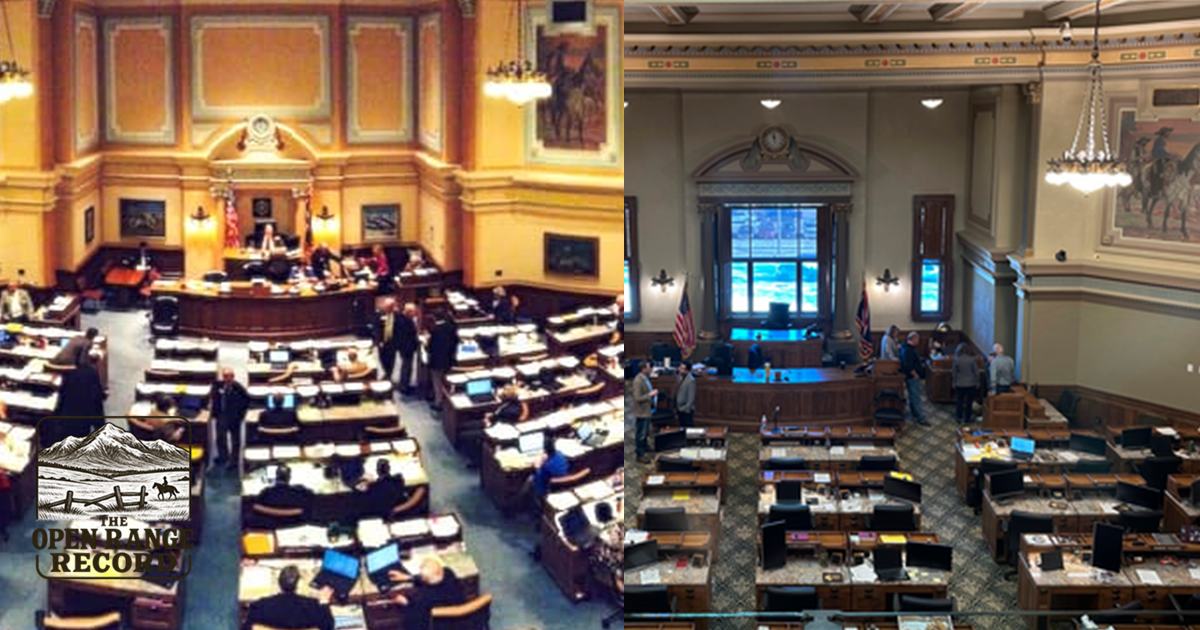
Covid began to change all of that. While House and Senate members already had their own computer, big monitors were added to each desk. In trying to limit the number of people on the floor, no longer did the group of people come in early to organize the desks. Legislators began taking care of their own files. Large monitors were added to each desk so they could now view all the amendments on the monitors, and the paper flow went way down.
While some continue to use multiple monitors, most of them were taken back down as they limited space on the desks. For a lot of the older legislators who had been there for many years, the amendments appearing on the screen were irritating as they preferred to hold the paper in their hand and write their notes in the margins. Sen Charlie Scott, who has been in the legislature for many years, does not use a computer but has a large shelf above his desk with the bills and statute books spread across the top. He simply refuses to use the new technology.
With younger legislators moving into the building, technology is beginning to change with the times. New programs and spread sheets, and different ways of doing research have evolved. No longer do the legislators pore over statute books in the library or carry heavy boxes of books around. They can go to their computers and have everything at their fingertips.
Now with (AI) programs, research is becoming so much easier. But is it always correct?
One of the legislators this year has dealt with false information about a vote he made. He had a constituent call several times hurling profanity and anger at one of his votes. When the legislator finally was able to talk to the person directly, they found out that the person had looked up his information on CHAT GPT. The legislator gave him proof that the (AI) version was wrong. The caller said, “Oh, sorry. I fully support you then.” But what if legislator had not taken the time to talk with the man and show him his flawed data?
As the expansion of (AI) technology continues, legislators will have to grapple with several different sides of the argument. The task is to write laws that protect the consumer while at the same time not squelch new innovations.
There is also the changing of some of the long-held procedures and moving into using different forms of (AI) on the floors of the hallowed chambers.
Whether using CHAT GPT to write debate speeches for the floor or using (AI) programs for doing research on bills, it is fortunately or unfortunately here to stay. In the future instead of asking if what we are listening to is Memorex, the question will be and perhaps already is, “is it real or is it AI?”