NEWS
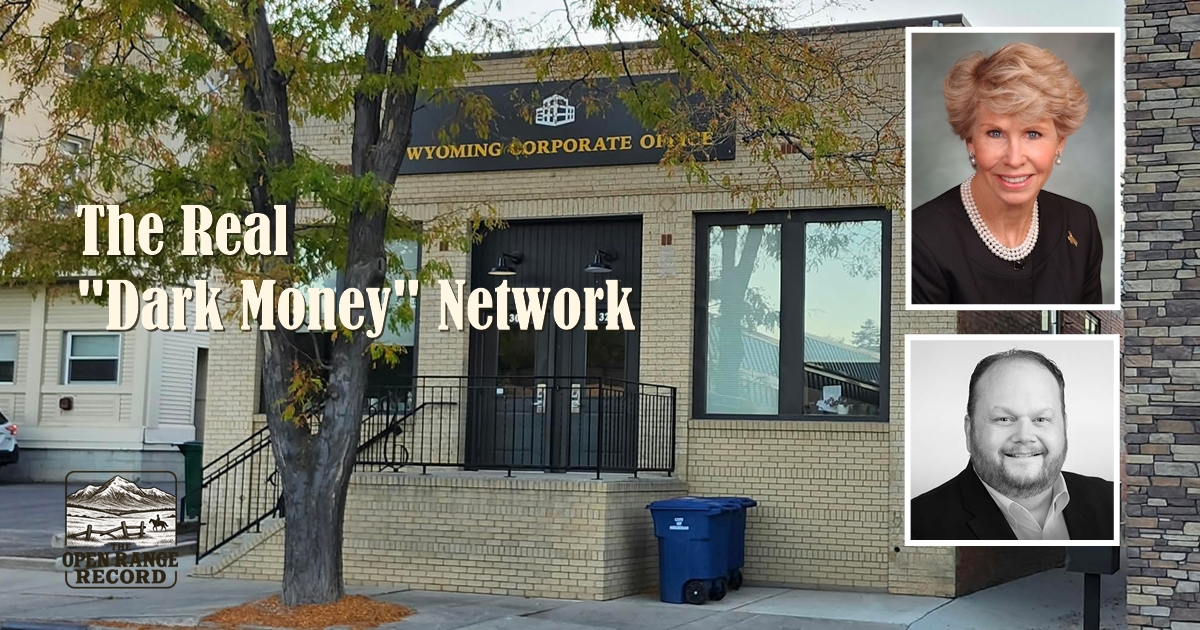
At 30 North Gould Street in Sheridan, thousands of businesses share an address through a commercial registered-agent service. Two names using that address also turn up in Wyoming’s campaign-finance records: Way Back PAC and Western Futures Fund. One gives money to candidates. The other supplies a substantial share of that money without publicly naming its donors.
The address had already drawn attention from state officials. In March, the Wyoming Secretary of State’s Office included the location in its audits of commercial registered agents. Months later, Way Back PAC’s primary report showed millions moving through a committee receiving mail at Suite 4205.
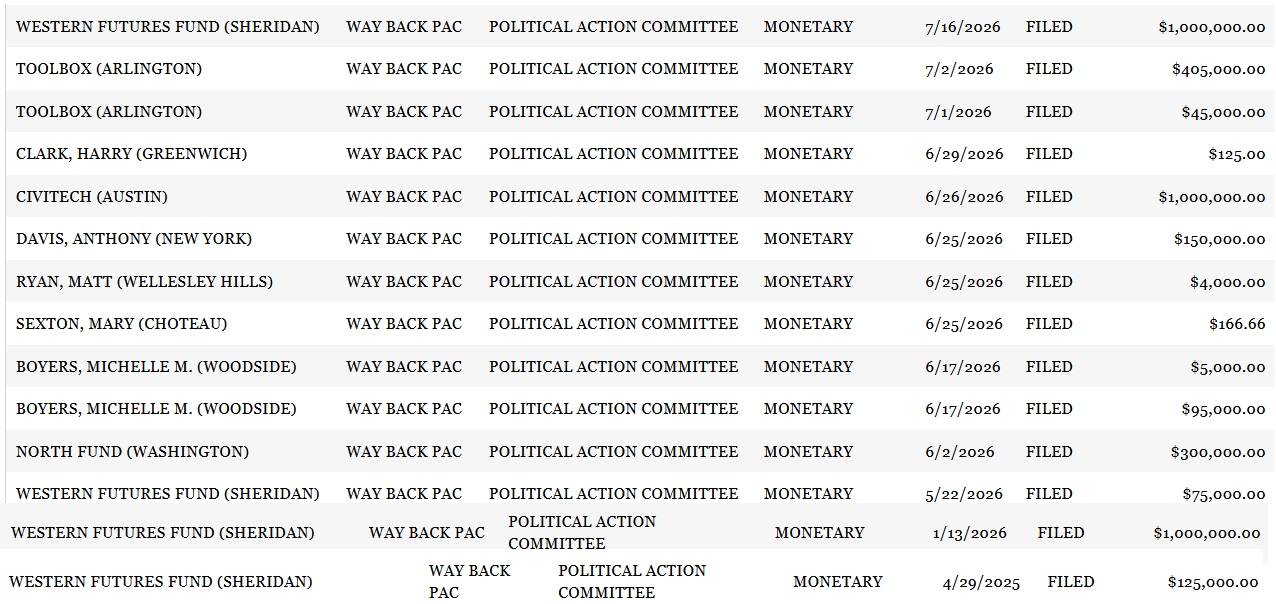
During the 2026 primary reporting period, Way Back PAC took in about $6.14 million and spent $6.43 million, including its August amendment. Its work reaches beyond Wyoming, so those figures cover a broader operation than the state’s primary. But some of the money went directly to campaigns Wyoming voters would recognize.
The PAC reported $43,000 in direct contributions to Wyoming campaigns. Recipients included Julie Jarvis, Myca Sturtevant, Robert Short, Elissa Campbell, Cam Wright, Karyn Chin, Luke Reiner, and Eric Barlow, among others. That total covers campaign donations; advertising purchased independently of a campaign is a separate kind of spending.
Behind those donations stood Western Futures Fund, which supplied $2.075 million to Way Back PAC during the same reporting period. Its address was also 30 North Gould Street, with a different suite number. Following the money back from a candidate’s campaign therefore leads to a PAC, then to a nonprofit at the same Sheridan address.
Behind the donations
At Western Futures Fund, known as an election-funding pass-through, the public donor trail becomes harder to follow. The organization is a 501(c)(4) social-welfare nonprofit whose public tax return does not name its contributors. A Way Back PAC filing can disclose Western Futures Fund’s contribution without revealing the people who originally supplied that money.
An election-funding pass-through organization acts as a middleman, collecting money from donors or other organizations and distributing it to groups that influence elections. Western Futures Fund is a good example of this, receiving grants from larger funding organizations and making grants to political and advocacy groups. Those recipients can use the money for advertising, voter outreach, and other activities, while public filings may identify the intermediary rather than the original donors. Each additional layer makes it harder for voters to trace who ultimately financed the political messages they see.
Some funding becomes visible from the other direction. Organizations making grants disclose their recipients, and the 2024 returns of Sixteen-Thirty Fund and New Venture Fund show more than $4.5 million going to Western Futures Fund. Both the Sixteen-Thirty Fund and the New Venture fund are massive left-of-center funding organizations reporting $106.5 Million and $624.9 Million respectively as of 2025.
The New Venture Fund is a 501C(3) non-profit while the Sixteen-Thirty Fund is a 501C(4). The difference being, a C(3) organization usually discloses the source of its funding; a C(4) does not. In other words, Wyoming political action committees saw donations the origin of which did not have to be disclosed from the Sixteen-Thirty Fund. The biggest disclosed donors to both of these organizations are Hansjörg Wyss, Bill Gates, Melinda French Gates, and George Soros.
New Venture Fund requires those grants to serve charitable purposes and prohibits using them for candidate contributions or campaign coordination. Its grant cannot simply be traced onward to a Wyoming candidate. The records show transfers between organizations, but do not identify which original donor financed a particular campaign contribution.
Western Futures Fund’s reach extends beyond the Way Back PAC. Its 2024 return also lists Wyoming Way PAC, Wyoming Donor Alliance, and Better Wyoming Action and Research among its recipients. Money leaving the organization supported several groups working in Wyoming politics, each with its own role.
The Wyoming Donor Alliance spelled out an election goal in its “Take Back the House” fundraising appeal: break the Freedom Caucus majority by flipping at least seven House seats while defending others. During the primary, PAC for a Better Wyoming reported $455,000 from the alliance.
The Way Back PAC has its own place in that picture. It is federally registered as a hybrid PAC, allowing it to make candidate contributions and conduct independent election spending through separate accounts. “Hybrid” describes that financial arrangement; it does not mean the committee is bipartisan or part of the Republican Party.
The names on the paperwork
The name on Way Back PAC’s federal registration is Ryan Lance, its treasurer. The January 2026 filing again names him, lists Jonah Meyers as assistant treasurer, and includes Western Futures Fund in the committee’s organizational relationship disclosures.
Lance’s name also appears on boards with a role in Wyoming’s economy and nonprofit work. A Cheyenne attorney, he serves on the Wyoming Business Council, the state’s publicly funded economic-development agency, and the George B. Storer Foundation.
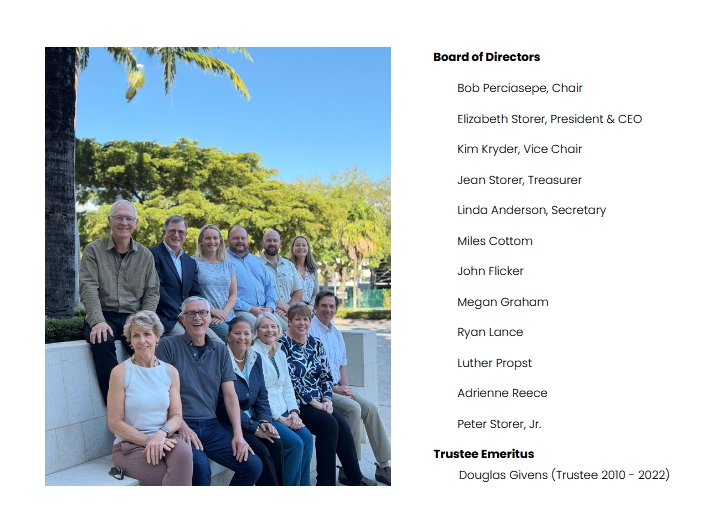
On the foundation board, Lance serves alongside Teton County Commissioner Luther Propst. Propst’s campaign received money from Way Back PAC. His wife, Democratic state Rep. Elizabeth “Liz” Storer, leads the George B. Storer Foundation as president and CEO, and also serves on Better Wyoming’s board.
Meyers connects the campaign filings to the organization handling Western Futures Fund’s daily work. After working at Arabella Advisors, a firm serving philanthropic organizations, he worked through Blue Moon Strategies. Arabella Advisors has been described as the “mothership” of a “massive progressive dark-money group” by the Atlantic and as “a Washington consulting firm […] that has funneled hundreds of millions of dollars through a daisy chain of groups supporting Democrats and progressive causes” and “a leading vehicle for [dark money] on the left” by the New York Times.
Western Futures Fund names Blue Moon as responsible for its day-to-day operations, and Way Back PAC also reported paying the firm for consulting.
Western Futures Fund’s president, Michael Hennesy, signed the 2024 return disclosing those arrangements. Jeremy Krones is its treasurer. Their return names the organizations receiving money, including the Wyoming groups, while leaving the contributor names undisclosed.
The Storer Foundation adds a charitable funding relationship to the organizations already appearing in the political records. Its 2024 grants included Better Wyoming and the Wyoming Civic Engagement Network. These grants are separate from Way Back PAC’s candidate donations. At the Civic Engagement Network, Democratic state Rep. Karlee Provenza works as a field strategist. Her husband, Nate Martin, leads Better Wyoming.
In Teton County, several of these relationships met in the same primary race. Way Back PAC contributed to Karyn Chin; Luther Propst, Liz Storer’s husband; and Ali Dunford.
Storer’s Keep Jackson Whole PAC promoted all three, and each campaign paid the consulting firm Mountain Movement Strategies. That firm also received payments from Wyoming Way PAC, another Western Futures Fund recipient. Chin, Propst, and Dunford all won their Democratic primary contests.
From campaigns to public decisions
While these groups were preparing for the primary, the Wyoming Business Council was fighting for its future. In January, Lance joined the agency’s board statement opposing legislative efforts to dismantle it. He now serves as the board’s secretary and treasurer.
By May, Lance was arguing that the Wyoming Business Council should have more authority over the public money it recommends awarding. Final approval for Business Ready Community grants and loans currently rests with the State Loan and Investment Board, made up of Wyoming’s five statewide elected officials.
Lance wanted that decision moved to the Wyoming Business Council. In the agency’s account of the May meeting, he said, “We need the Business Council to be the final arbiter of grant and loan awards.”
The private Wyoming Business Alliance, a separate organization that helped establish the Wyoming Business Council, defended the agency as well. Better Wyoming opposed legislation terminating it.
The campaign against Proposition 1 brings another Lance connection into the November election. Vote No on Prop 1, the committee opposing the homeowner property tax exemption, paid Lance & Hall for legal services. Ryan Lance’s wife, Elizabeth “Beth” Lance, is the firm’s founding partner; the filing records payments to the firm without identifying which attorney performed the work.
The Wyoming record of 30 North Gould Street reaches candidate campaigns, nonprofit boards, and debates over taxpayer money. The filings disclose many of the transfers along the way. When a contribution comes through Western Futures Fund, however, the candidate’s campaign can name the PAC, the PAC can name the nonprofit, and the non-profit’s public return still leaves the original contributors unnamed.
Taken together, these records show how national left-of-center funding connects to Wyoming politics through a series of nonprofits, donor alliances, and political action committees. Western Futures Fund occupies a central position, receiving grants from national organizations while supplying money to Way Back PAC and other groups active in the state.
Around that funding structure are overlapping consultants, board members, and advocacy organizations, with the Wyoming Donor Alliance openly declaring its objective of breaking the Freedom Caucus majority. Not every dollar followed the same route, and not every organization served the same purpose. But there was substantial financial infrastructure behind efforts to shape Wyoming’s 2026 primary.
For voters, the difficulty is that disclosure at each step does not necessarily reveal who paid at the beginning. A candidate reports a contribution from a PAC, the PAC identifies a nonprofit, and the nonprofit’s public filings leave its original donors unnamed. Republican candidates can therefore receive support through organizations financed by the national left without their campaign reports making that larger relationship apparent. Wyoming voters can see the final contribution, but understanding the interests behind it requires following a trail across years of filings and multiple organizations—and even then, the people who supplied the money may remain out of sight.
One thing is clear: a complicated funding network connected national left-of-center organizations to political groups supporting left-leaning Republican candidates in Wyoming’s 2026 primary. Well-connected Wyoming political insiders held key positions throughout that network, while layers of nonprofits and PACs made it difficult for voters to identify the original sources of the money.
Sources
1. Shared boards. Storer Foundation board · Better Wyoming board and staff
2. Meyers and Blue Moon. University of Maryland career update · Western Futures 2024 return, Schedule O · Way Back consulting report
3. Storer charitable grants. 2024 Form 990-PF, grants paid The return lists Better Wyoming and the Wyoming Civic Engagement Network under grants paid.
4. Provenza and Martin. Better Wyoming announcement of joint training · October 15 reporting identifying their marriage
5. Shared network leadership. WyCEN joint executive-director recruitment notice
6. Teton County endorsements and primary results. ShelterJH primary endorsements · ShelterJH endorsement history
7. Teton County consulting and PAC connections. Keep Jackson Whole paid political message · Wyoming campaign-finance portal How the Money Lines Up and How the Money Reaches the Slate summarizes the Teton County consulting relationships.
8. Business Council role and funding authority. Board roster and final-approval explanation · January board statement · May 22 council account of Lance’s remark
9. Organizations and council funding. Business Alliance history · Better Wyoming council messaging · Common Sense Republicans candidate questionnaire
10. Pathfinder and Martin’s Cove. Pathfinder rebrand and business background · Wyoming Friends for Martin’s Cove proposal
11. Propst and Meyers conservation roles. Sonoran Institute 2012 annual report · Outdoor Alliance board transition · Outdoor Alliance Meyers profile
12. Vote No on Prop 1 legal services. Official finance portal · Lance and Hall biographies · State Bar biography Committee report filed August 7, pages 3–5, records payments to the firm during June–August.
13. Better Wyoming position on Proposition 1. Property-tax FAQ · Public-services argument