OPINION
We are told that Wyoming has its own brand of conservatism—that what is conservative here is somehow different from what is conservative elsewhere in the country. It is as if dictionaries function differently west of the Dakota line, and that political principles are required to change clothes when they cross into the Powder River Basin.
Nearly every political mailer sent to Wyoming voters this year invoked the word “conservative.” In many parts of the state, elections boiled down not to which candidate offered the best policy ideas or proved most capable of defending them. The question became who was more of a Wyoming conservative than whom.
That should have produced a serious discussion about the meaning of conservatism. Instead, the word was stretched, folded and twisted until it could be wrapped around nearly anyone even slightly resembling a Republican. Even when candidates themselves advocated for gigantic government programs far outside the scope of anything approaching the Republican Party, a litany of political organizations maintained they were conservative.
Pundits of questionable political philosophic prowess insisted for months that the age of a policy is somehow a measure of how conservative it is. If Wyoming government had been doing something for decades, continuing to do it was supposedly “traditional.” Column after column made the absurd claim that adding the word conservative to mountains of spending or never-ending central planning made it the second coming of Ronald Reagan.
But conservatism is not an heirloom saddle. It cannot be inherited merely because one’s grandfather owned it. A family’s history in Wyoming may be admirable, and it may establish a deep connection to the state. It says nothing, however, about whether a candidate believes in limited government, individual liberty, private property, or personal responsibility.
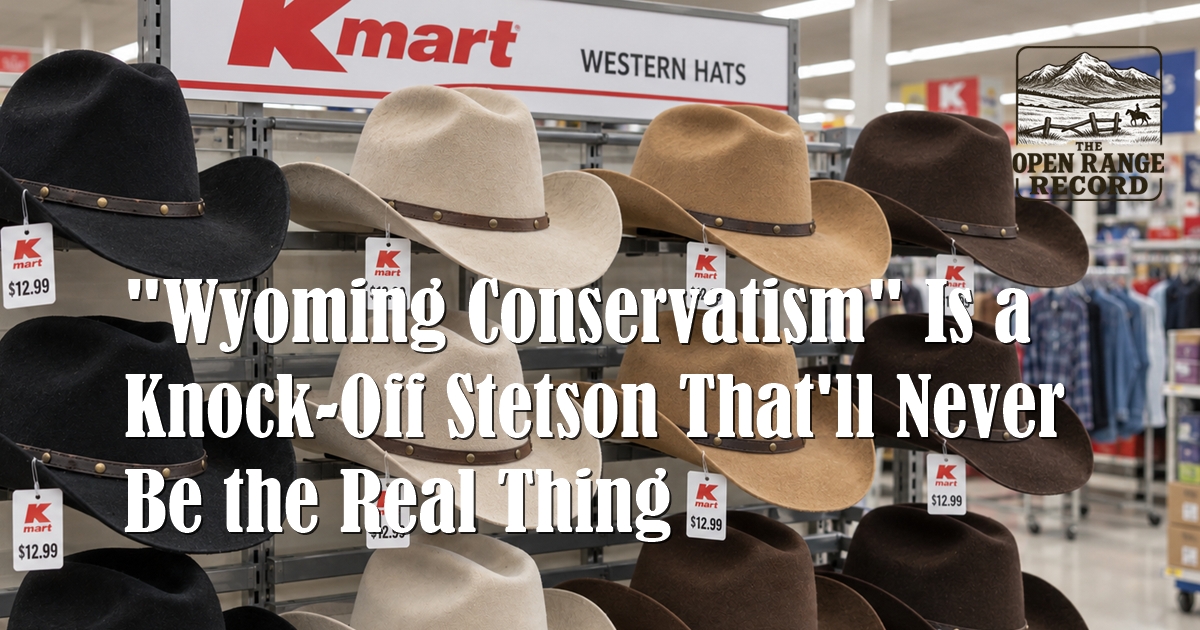
Nor does the age of a government program determine its political character. A subsidy does not become conservative because the state has distributed it for 30 years. Central planning does not become rugged individualism because it is conducted from a building in Cheyenne. A subsidy wearing a knock-off Stetson is still a subsidy.
The insistence that words can mean something entirely different in Wyoming is an exercise in political relativism. It allows principles to be replaced by circumstances and definitions to be replaced by convenience. A policy is conservative, under this theory, not because of what it does, but because the people defending it have decided to call it conservative.
William F. Buckley Jr. recognized that habit more than six decades ago. In Up from Liberalism, he described modern liberalism as embracing the proposition that “truths are transitory and empirically determined.” If truth is temporary, then political definitions can be temporary as well. Words need not retain any permanent meaning; they need only serve the immediate argument. And the immediacy of elections creates a lot of conservatives in Wyoming.
Under that approach, yesterday’s expansion of government becomes today’s conservative tradition. A government agency created to direct the economy becomes a cherished Wyoming institution. Public money transferred to favored private businesses becomes “economic development” instead of the crony capitalism that it really is. The vocabulary changes; the underlying policy does not. If it wasn’t conservative when it was enacted, it certainly isn’t now.
Buckley’s conservatism was not simply an attachment to whatever happened yesterday. To him, conservatism was the fusion of traditionalism, libertarianism, and anti-collectivism. He believed faith, a morally ordered society, individual freedom and free enterprise, and a strong antipathy to any form of collectivist utopian ideas formed the intellectual framework of it.
Those principles included individual freedom, private property, family, community, conscience, inherited wisdom, and a spiritual understanding of human life. Buckley acknowledged that conservatives must adapt their methods to present realities, but he rejected the idea that principles should be surrendered whenever political winds shifted. He put the matter plainly: “I will not cede more power to the state.” That sentence does not acquire an asterisk upon reaching Wyoming.
Barry Goldwater was even more direct. In The Conscience of a Conservative, he described politics as the art of securing the greatest possible freedom for individuals consistent with the maintenance of social order.
Goldwater understood that government has legitimate responsibilities. It must protect rights, administer justice, preserve order, and defend the country. But he also understood that political power possesses an appetite. It rarely surrenders authority voluntarily, and it almost always discovers new reasons to expand.
That is why Goldwater said the conservative’s first question should be: “Are we maximizing freedom?”
Notice what the question is not.
It is not: How long has Wyoming done this?
It is not: How many generations has this politician’s family lived here?
It is not: Is the program popular with influential industries?
It is not: Can government attach the words “Wyoming values” to the press release?
Does it leave individuals more capable of directing their own lives, or does it transfer additional authority to government? Does it protect private property, or does it take from one person to subsidize another? Does it encourage responsibility, or does it reward political connections? Does it locate decisions with individuals, families, and local communities, or with administrators and appointed boards?
Those questions reveal the emptiness of the claim that Wyoming conservatism can mean the opposite of conservatism everywhere else. Wyoming certainly has a distinct culture. Our sparse population, ranching history, mineral economy, enormous federal land presence and open spaces produce circumstances unlike those of New York or California.
Those circumstances influence which issues matter most and how policies must be applied. But circumstances do not reverse principles. It is the lack of principles that exposes how vacuous those claiming to be “Wyoming conservatives” actually are.
Gravity operates the same way in Wyoming as it does in Massachusetts. Two plus two does not equal five because the calculation was performed on a ranch. In the same way, a policy that enlarges government authority does not become limited-government conservatism merely because it was enacted in the Cowboy State.
There can be honest disagreements among conservatives about how principles apply to a particular problem. But disagreement over application is different from abandoning the principle altogether. A person may argue that a particular government program is necessary, beneficial, or popular. What he cannot logically do is prove the program conservative merely by calling it “Wyoming conservatism.” That is not a definition; it is a euphemism.
It permits candidates who advocate for larger government, state-directed economics, subsidies, mandates, and collective solutions to retain the conservative label without reconciling those policies with conservative principles. Rather than defending the contradiction, they declare that no contradiction exists because Wyoming conservatism is somehow different. Those things may be a political philosophy, but they are the opposite of the conservatism described by Buckley and Goldwater.
Calling it “traditional” does not solve the problem. Every entrenched government program eventually becomes traditional if it survives long enough. By that reasoning, the New Deal, the Great Society, and virtually every federal bureaucracy would now qualify as conservative merely because they are old. That, of course, is preposterous.
The real test of Wyoming conservatism is therefore not genealogy, geography, or political branding. It is whether the policies presented under that name remain faithful to the principles the word has historically represented.
Wyoming may have its own landscape, its own industries, and its own political temperament. It does not have its own laws of logic, dictionary, or brand of conservatism. There isn’t a knock-off Stetson, a Copenhagen ring on a pair of Bermuda shorts, or a Cheyenne liberal that used to live in the Red Desert that can change that--no matter how many folksy op-eds he may write.