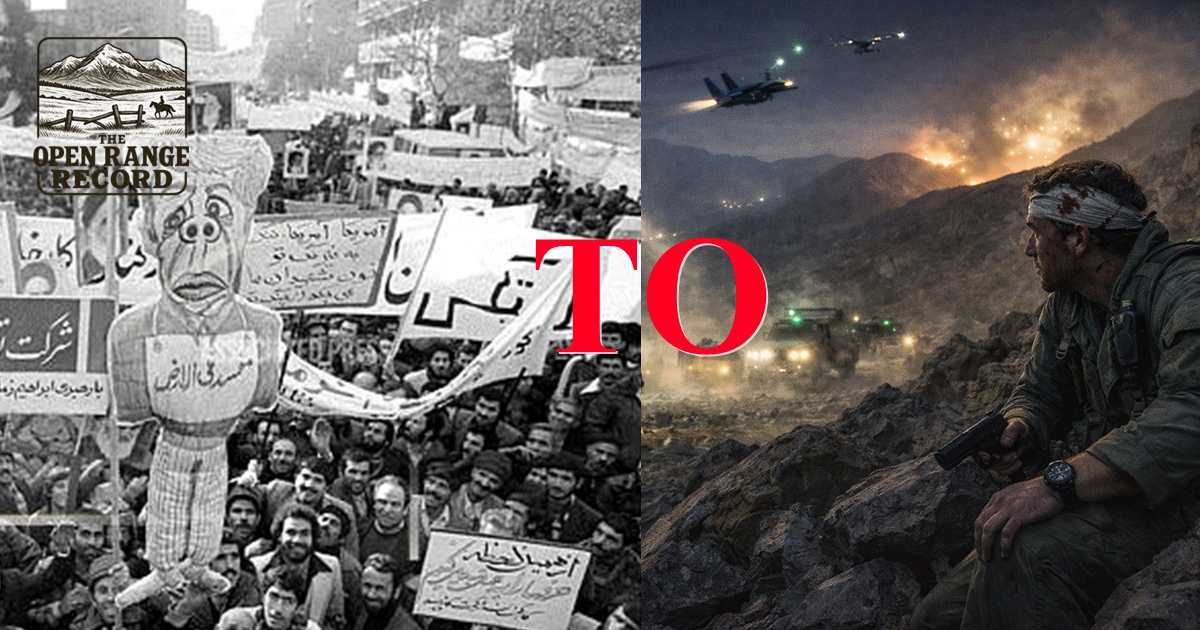
America just witnessed an Easter Miracle. The two F-15 airmen shot down over Iran on Good Friday, were rescued. The pilot was saved first, and the wounded navigator was rescued on Easter Sunday. The intensive search and rescue mission, involving hundreds of America’s finest special forces, had an important Wyoming connection.
The recent rescue mission was conducted hundreds of miles behind enemy lines in the remote Iranian desert, and it bears an uncanny resemblance to the last time America attempted a rescue mission in Iran. The back-story begins in November 1979, when Islamic fanatics took over the American Embassy in Iran. They violated international law and took more than 50 Americans hostage.
American Special Forces went to work planning a rescue mission. It involved both air and ground special operators, who landed at a pre-staging area in the Iranian desert. When the task force arrived, they were one helicopter short, so they aborted the mission. Upon take-off, a helicopter crashed into a parked MC-130 that burst into flames, killing eight brave airmen. The movie “Delta Force” opens with the late Chuck Norris and Army Special Forces (SF), escaping the burning wreckage of the aircraft.
In the aftermath, it was realized that the mission had a thrown- together, “ad hoc” nature to it. The different branches of SF weren’t used to working together. America’s conventional forces had worked together for years, but our most elite special forces had not. Air and ground special operators had difficulty working together, because each service had its own unique supply lines, tactics, and even radios. They had trouble talking to each other, both figuratively and in fact. That had to change.
Out of the ashes of that tragic mission rose the Phoenix of a newly created command that was dedicated to insuring that American special forces of all branches could work together to save any American held in a foreign land. The Army, Navy, and Air Force special operators began training together. When they work together it’s termed “joint.” They developed highly specialized “joint” tactics, designed to save Americans behind enemy lines.
Yes, we’d been doing this in a service-isolated way since Vietnam, but this was the first command dedicated to inter-service or “joint” special operations. After the attempted Iranian rescue mission failure in 1980, the “new and improved joint special operators” led the way on the near-perfect, 1989 Panama Invasion. Joint special operations was a resounding success.
So how did Wyoming figure into the F-15 Easter Miracle? About three years ago, an exercise was conducted on a remote highway outside of Casper. It involved an MC-130, helicopters, and special forces that formed the same core package used to rescue the downed airmen in Iran. On a pitch-black morning in April 2023, an MC-130 landed on that remote highway and off-loaded small helicopters, that flew away into the night to rescue a simulated downed-airman. An A-10 “Warthog” flew in to provide cover fire.
The airman was rescued, and the entire package rolled up and took off to safety. At sunrise we left no indication we were ever there, except for some tire marks on the highway. Mission accomplished, and a new concept of joint interoperability proven. A new tool in America’s spec-ops toolbox was added because Wyoming offered the perfect testing location.
When our F-15 was shot down over Iran, this “proven-in-Wyoming” rescue package launched into action. Both the pilot and navigator/WSO were safely rescued. The only glitch was that there wasn’t even a remote highway in that part of the Iranian desert, so the MC-130s landed on a supposedly dry lakebed that turned out to be not so dry. They got stuck in the wet sand.
After the navigator was rescued, more aircraft flew in to extract all personnel. The mission planners had wisely put together a back-up plan. Always have a “plan B.”
America’s special operators had come full circle. The aborted 1980 Iranian rescue mission left eight American heroes and an MC-130 at the crash site in the ghostly desert. But this time, we successfully rescued downed American airmen, then destroyed the aircraft to prevent our technology from falling into enemy hands. No casualties and no one left behind. Mission accomplished.
The smoking wreckage of MC-130s left in the Iranian desert, from events separated by decades are worlds apart. Our 47th President is just settling a 47-year-old score. Payback.
We owe a huge debt of gratitude to the elite special operators who always have, “The Guts to Try.”