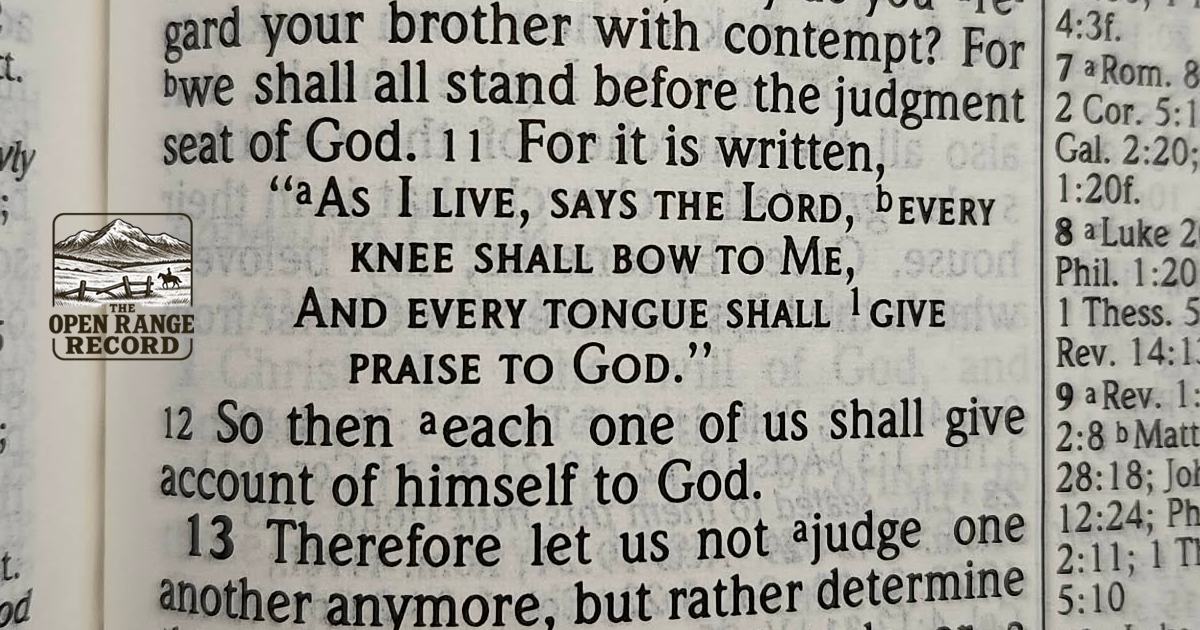
Accountability is the willingness to answer for our actions: honestly, humbly, and without excuse. It is more than confession. It is ownership. It is the courage to stand in the light when it would be easier to hide in a world that has moved from black and white, to grey.
As Thomas Paine warned, “A body of men holding themselves accountable to nobody ought not to be trusted by anybody.” A society without accountability, whether in government, media, business, church, or home, eventually corrodes from the inside out.
Accountability is not merely admitting fault. It is deeply understanding where things went wrong, feeling the emotional, spiritual, and professional weight of it, recognizing how it affected others, and then… through true repentance… taking steps to make amends. It means accepting the consequences, humbling yourself in the moment, and allowing the failure to shape you into someone better.
Accountability
without repentance is just a performance, a lie.
Accountability with true repentance becomes a testimony.
There are several types of accountability, and understanding the differences helps us see where it is strong, where it is distorted, and where it is missing altogether. For the sake of time, let’s discuss a few.
Selective Accountability is shifting blame, minimizing the harm to your community, and protecting personal ego through refusing to admit that those around you, or worse yet-yourself, can be hurtful, wrong, or make mistakes. It is arrogance at worst, and blind allegiance to family, friends, and community at best.
Selective accountability is the “but they…” defense.
1. “I was wrong, but they did worse.”
2. “But they’ve done so much for… in the past.”
3. “But they have been a friend of mine for years.”
4. “We have to protect family.”
Ignoring bad behavior in friends, family, co-workers, and community may feel easier in the moment: less conflict, less discomfort, less risk of losing the relationship. But long term, silence has consequences. What we tolerate, we indirectly endorse. What you publicly endorse is the perception of who you are. How do you want people to see you?
Spiritual accountability: If right and wrong have no foundation beyond preference, then accountability becomes optional; this holds true for non-believers, as well. What is the yardstick for right and wrong?
Many Christians echo a sentiment that morality is not socially constructed but rooted in God’s character. If there is objective truth, then we are accountable not only to one another, but ultimately to God. “If we’re not careful as Christians, we can fall into the trap of shaving off the edges of the truth so we can be liked.” Voddie Baucham
Without that anchor of truth, everything becomes negotiable. Black and white dissolves into grey. Everything becomes permissible, justified by emotion, convenience, or political advantage. Are we not seeing this daily? Everywhere?
Professional accountability builds trust. Leaders who admit mistakes gain 0credibility. Those who deflect blame lose it. As Phillip M. Holmes writes, “Every toxic leader has one thing in common: They see accountability as a threat, not a responsibility.” A leader who fears accountability will eventually demand silence instead of truth.
And as J. Milburn observed, “Accountability is a skill that needs to be modelled instead of enforced.” It begins at the top. Are our elected politicians being accountable for their behaviors: integrity, honesty, and voting records that they promised through campaigning?
What Happens When Accountability Is Absent?
When accountability disappears, power expands unchecked. Kevin Powers wrote, “Freedom is not the same as lack of accountability.” Freedom without responsibility is not liberty, it is chaos:
1. Truth becomes relative. When truth becomes relative, it no longer functions as a fixed standard. It shifts depending on preference, politics, emotion, or cultural trends. Truth becomes blurred, and right shifts based on what is popular. At first, this can feel freeing. Without absolutes, no one can tell you that you are wrong. But the long-term consequences are destabilizing, devastating, and nation ending.
2. Accusations become political tools. They can expose corruption, protect the vulnerable, and uphold justice. But when accusations are weaponized for political gain rather than grounded in truth, they become tools of manipulation instead of instruments of accountability.
3. Reputations are destroyed for leverage. Lives are devastated for political arrogance, power, and ladder-climbing. There is a profound difference between pursuing truth and pursuing advantage. Moral superiority replaces moral integrity.
What kind of person attributes criminality to another through political pandering? What kind of person viciously attacks someone, knowing it is a lie, simply because of differing political views?
It is easier to posture as morally superior than to be morally consistent. It is easier to adopt a savior complex than to examine one’s own hypocrisy. It is easier to bully than to repent. It is easier to call someone racist, sexist, or homophobic than to have a difficult, principled conversation grounded in evidence and truth.
Labeling accountability as “hate” does not make it so. Speaking truth is not inherently an attack. Honesty is not violence. Correction is not cruelty.
And yet, speaking in truth, doing what is right, is often the harder road. It costs relationships, reputation, comfort, and sometimes opportunity.
Without repentance, accountability is a lie, a public relations strategy. We can conform so thoroughly to cultural pressure that we lose both our courage and our integrity. With repentance, accountability becomes transformative, life changing, and shows the world a light that helps us through darkness. Accountability protects integrity. Integrity protects testimony.
We cannot always force accountability on others. But we are not powerless.
We can: vote leaders out who refuse responsibility, stop enabling destructive behavior, stay in contact both publicly and privately with our elected officials, donate time or money to better alternatives.
We can also boycott organizations whose actions contradict our values, whatever those values are.
Recent effective consumer boycotts:
1. Bud Light: 34%–37% drop in sales among regular buyers, resulting in over $1 billion in lost revenue for Anheuser-Busch. Bud Light lost its 21-year title as America's top-selling beer and suffered significant, lasting brand damage.
2. Jaguar: After a new branding campaign that alienated Jaguar’s normal base customers, they lost an astonishing 97.5% in European sales in 2025.
3. Disneyland: Several boycotts have targeted Disney on both sides of the aisle: Jimmy Kimmel suspension, controversial casting choices, and questionable hiring practices at their theme parks. Losses have been in the billions.
Whether one agrees with those movements or not, they demonstrate that citizens can respond when they believe accountability is lacking. Complaining without offering solutions is not accountability. Engagement is.
You can also use research and data to be accountable for your voting. Do you check in on the people you vote for and elect? Are they voting the way they said they would during their campaign? There are several areas you can do so in Wyoming! These sites track 100% of Legislative votes, tabulate statistics, show where politicians fall on Rep./Dem. scales, give full Legislator contact information, etc.
1. WyoLeg (https://wyoleg.gov)
2. WyoVote (https://wyovote.com)
3. WyoRINO (https://wyorino.com)
4. Evidence-Based Wyoming (https://evidencebasedwyoming.com)
5. Wyoaction (https://wyoaction.com)
Personal Accountability: The One Thing We Control
While we cannot guarantee accountability in politicians, media outlets, or institutions, we can control our own. We are accountable to: our conscience, our reputation, our testimony, our community, our friends and families, our actions, and our God.
If politicians become self-serving and no longer accountable to the people, they should step down. If media outlets abandon truth and journalistic integrity, they lose credibility. They should stop reporting. If individuals thrive on vitriol and “gotcha” narratives that destroy lives, they must reclaim their humanity.
What
Wyoming do we want to be?
What kind of neighbors? What kind of leaders? What kind of citizens?
Accountability is not about punishment; it is about restoration. It is not about humiliation; it is about humility. It is not about control; it is about character.
We must find our way back to being accountable to one another. Because without accountability, freedom erodes. Without repentance, apologies are hollow. Without truth, justice collapses.
With accountability, real, consistent, courageous accountability… communities heal, leaders grow, integrity leads, and freedom and faith flourish.
What will be YOUR testimony? “Do you know it was His mercy that woke you up this morning? Because his judgement should’ve killed you last night.” Voddie Baucham.