
NEWS
Logic and Accuracy (L&A) testing serves a straightforward purpose: to verify that election equipment records and tabulates votes accurately before ballots are cast. Just as importantly, the public testing process is intended to give voters confidence that election systems are functioning properly and that established safeguards are being followed.
Events surrounding Sheridan County's recent L&A testing have prompted questions about whether those objectives were fully met.
The testing was originally scheduled for Monday, July 13, but concerns arose before the process even began. Public notice of the testing was reportedly not posted on the County Clerk's website two days in advance, as required under Wyoming law. During the initial testing, approximately 3,132 test ballots reportedly failed twice to produce the expected vote totals, requiring officials to halt the process and reschedule.
What is typically completed in a matter of hours instead stretched over two additional days. Testing resumed Thursday, July 16, from approximately 8:00 a.m. until 3:30 p.m., and concluded Friday at approximately 4:10 p.m.
Observers who attended both days say the testing itself was only part of the story.
Unsecured Election Equipment
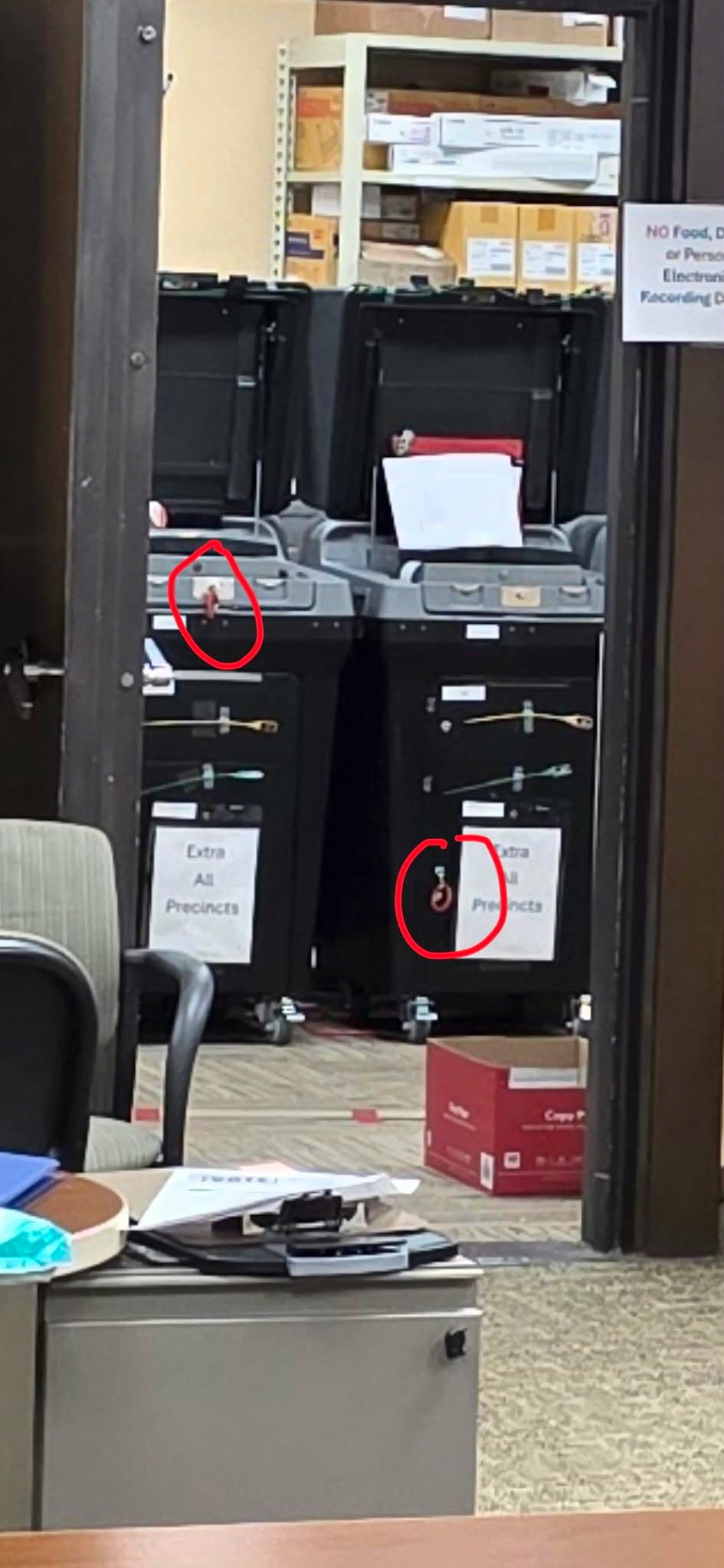
Two members of the public arrived shortly before the scheduled 8:00 a.m. start on Thursday. Although the Elections Office was open and lights were on, no employees were reportedly present for roughly 10 to 12 minutes.
During that time, the election vault door was open. Voting machines were accessible, keys remained in the machines, and no election staff were present to supervise access. On Friday, observers also reported seeing security seals scattered throughout the room and election media—commonly referred to as data sticks—left in the open.
Whether anyone intended to misuse the opportunity is not the central issue. Election security procedures are designed to eliminate opportunities for unauthorized access rather than rely on assumptions about individual intent. Chain-of-custody protections exist precisely to prevent circumstances in which election equipment can be accessed without oversight.
Questions Over Public Restrictions
Observers also questioned restrictions imposed on members of the public attending the testing.
According to those present, attendees were instructed that personal belongings could not be brought into the election vault because, they were told, the restriction came from the Wyoming Secretary of State's Office.
Several attendees sought clarification. One reportedly contacted the Secretary of State's Office immediately, while others questioned Clerk Eda Schunk-Thompson directly regarding the legal authority for the restriction.
After those inquiries, attendees say they were informed by the Secretary of State's Office that it had issued no such directive and had not instructed county officials to prohibit personal belongings. According to those involved, the office indicated it would contact the county to address the matter.
Observers reported that the explanation changed the following day. Rather than attributing the restriction to the Secretary of State's Office, the Clerk reportedly stated that she had authority to determine procedures within her own election vault and that the Secretary of State could not dictate how her office operated.
The differing explanations have raised questions about what authority, if any, supported the original restriction.
Security Seals and Chain of Custody
Security seals play a significant role in election administration by providing evidence that voting equipment has not been accessed after testing is complete. State law prescribes not only when seals are used but also the type of seal required.
Observers reported seeing seals throughout the Elections Office during testing. Some remained attached to equipment, others were lying on tables, and additional seals were reportedly stored in open bags accessible within the room.
Several attendees also stated they were instructed to retrieve seals themselves, select the appropriate ones, and place those seals on voting machines following testing.
If accurate, those observations mean members of the public—not election staff—participated in sealing equipment intended for use in a public election. Regardless of intent, such circumstances raise questions about whether chain-of-custody procedures were consistently maintained.
Observers also questioned whether plastic seals were used where Wyoming statute requires metal wire seals.
Election Media Handling
Election media, often referred to as data sticks, contain the programming and data necessary for voting equipment to record and report election results. Maintaining documented control of that media is a fundamental component of election security.
According to observers, Thursday's testing was delayed because the election media had not yet been fully prepared. During portions of that process, the data sticks reportedly remained in open baskets within the Elections Office.
Observers further stated that during the lunch break the media were left unattended on a desk rather than secured in the election vault while staff left the office.
The county's IT manager, who assisted during Thursday's testing, was absent Friday after reportedly providing staff with instructions for completing portions of the process independently. Throughout the testing, observers described continued difficulties involving election media programming, insertion procedures, and operation of the voting systems.
At the conclusion of testing, members of the public were reportedly instructed to insert election media into voting machines before applying the final security seals.
Each additional person who handles critical election media expands the chain of custody and increases the importance of thorough documentation and oversight.
Public Confidence
Sheridan County Clerk Eda Schunk-Thompson is not only the county's chief election official but also a candidate for re-election to the office responsible for administering county elections. That circumstance places added importance on transparency, consistency, and strict adherence to established procedures.
The concerns raised by observers do not depend on speculation about what may have occurred behind closed doors. Instead, they focus on events reportedly witnessed in plain view: an election vault left open without staff present, keys left in voting machines, election media reportedly left unattended, security materials openly accessible, members of the public participating in handling election equipment and seals, and conflicting explanations regarding restrictions placed on observers.
Election integrity is measured not only by whether vote totals are ultimately correct, but also by whether every safeguard designed to protect those results is consistently followed and publicly verifiable.
For many voters, the questions raised during Sheridan County's Logic and Accuracy testing are ultimately questions about confidence. Confidence depends on secure procedures, documented chain of custody, and consistent application of established election protocols.
The issue facing Sheridan County is not simply whether votes will be counted accurately. It is whether the public can be confident that every safeguard intended to protect those votes was followed from beginning to end.
The Open Range Record previously reported that the Sheridan County Elections Office failed their initial test of the vote tabulation machines on Monday July 13. After which, Sheridan Clerk Edna Schunk -Thompson did not show up for the Sheridan GOP debate she had RSVP’ed to attend.