A Question of Direction
Should the State of Wyoming be competing with its own citizens—especially the next generation of farmers and ranchers—for productive land and water?
Should we be shifting from partnership-based access to state ownership?
These questions are no longer theoretical. They are playing out right now in Goshen County, where the proposed acquisition of 368 acres near the Table Mountain Wildlife Habitat Management Area is under consideration by the Wyoming Game and Fish Commission for hunting access and wildlife habitat.
The Next Generation at Risk
For young people hoping to stay in Wyoming and build a life in agriculture, access to land is already one of the greatest barriers. For multi-generational operations, expansion is often necessary for survival. When productive land leaves the private market, those opportunities diminish.
Understanding the Scale
To understand the scale, consider this: a standard section is 640 acres. This proposed purchase—368 acres—is well over half a section and would expand the existing Table Mountain area by roughly 20 percent.
It is also important to understand the existing footprint. The Table Mountain Wildlife Habitat Management Area already encompasses roughly 1,700 acres. When combined with the nearby Springer and Bump-Sullivan Wildlife Habitat Management Areas—estimated at approximately 4,000 to 5,000 acres—the Wyoming Game and Fish Department already manages an estimated 6,000 to 7,000 acres in Goshen County alone.
The Bigger Picture in Wyoming
Looking beyond the county, the broader land-use picture becomes even more significant. The Wyoming Game and Fish Department owns approximately 168,000 acres statewide, while also managing access to millions of additional acres through cooperative agreements and public access programs. At the same time, the federal government controls roughly 48 percent of all land in Wyoming—nearly 30 million acres.
In addition to direct ownership, a substantial amount of land is already influenced by conservation programs. In Goshen County alone, approximately 132,840 acres are enrolled in the Conservation Reserve Program (CRP), with millions more acres statewide under conservation easements and related restrictions.
The Growing Pressure on Land
When viewed together—state acquisition, federal ownership, conservation programs, and expanding industrial wind, solar, and data center development—the cumulative impact is clear: Wyoming is steadily removing productive land from use, creating an artificial scarcity that drives up costs and threatens the agricultural foundation that built this state.
At some point, we must ask: when is enough enough?
Agriculture: The Foundation of Habitat
Goshen County has long supported strong populations of pheasants, ducks, and geese, making it a valuable area for hunters. But that success is not incidental—it is the result of agriculture. Irrigated fields, water delivery systems, and active land management provide the food, cover, and water that sustain wildlife. Without agriculture, much of this habitat would not exist in its current form.
Agriculture and wildlife are not competing interests here—they are interconnected. That means we already support hunting access—but we must also protect the agricultural systems that make that access possible in the first place.
What Kind of Land Are We Creating?
This issue is not just about acres—it is about what kind of acres.
The land in question includes irrigated agricultural ground supported by adjudicated water rights. Today, it produces. It contributes to families, agriculture, and the local economy. Once it transitions into state ownership, it becomes something different—a publicly managed asset that must be funded, maintained, and overseen through fees, license revenues, and taxpayer support.
That raises an important question: what are the long-term costs of converting productive land into publicly managed ground—and who ultimately pays for it?
A Generational Impact
Goshen County is one of Wyoming’s most productive agricultural regions, stewarded by private landowners. Continued removal of productive land from private use has real consequences—not just economically, but generationally.
This is about more than a single parcel—it is about the future of agriculture in Wyoming.
Now Is the Time to Engage
Wyoming citizens have an opportunity to engage directly on this issue.
A public meeting will be held Monday, May 11, from 6:00 to 7:00 p.m. at the Platte Valley Bank meeting room, 2201 Main Street in Torrington, to discuss wildlife habitat management areas and this proposed acquisition.
Public comment may also be submitted online at:
https://wgfapps.wyo.gov/WGFD_WebSurvey/CommentOnly.aspx
These are decisions worth engaging in before they are finalized.
A Final Thought
Because once Wyoming’s land and water are transferred out of the hands of its people and into permanent government control, the opportunities they created for generations are not easily reclaimed—and the cost is borne not just today, but by every generation that follows.
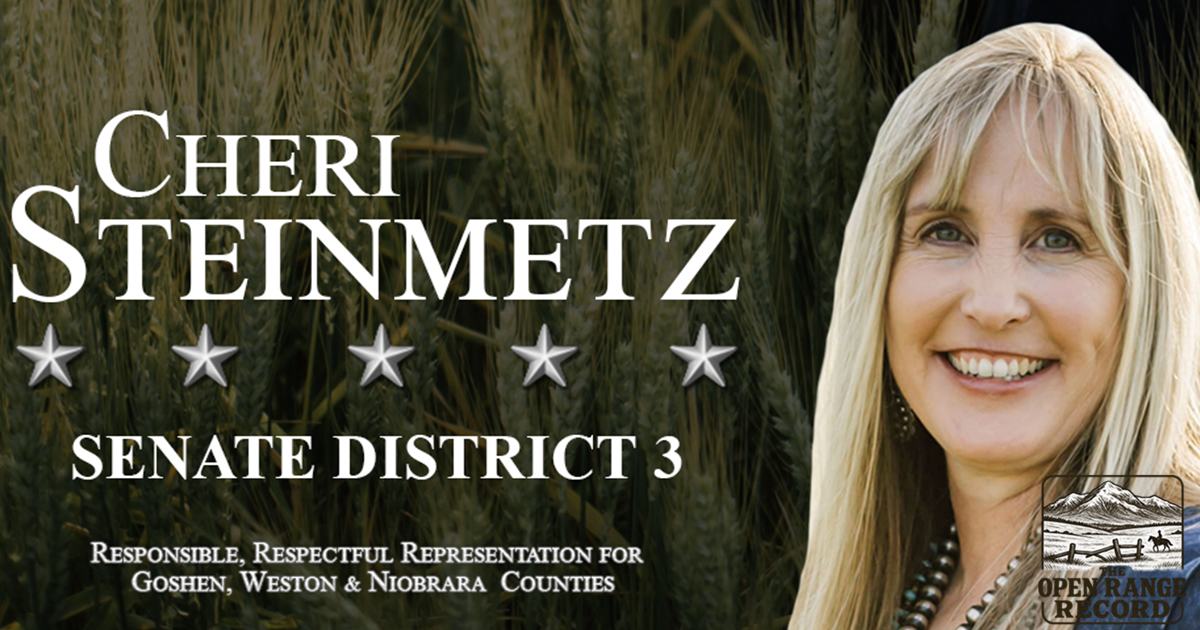
Senator Cheri Steinmetz represents Senate District 3 - Goshen, Niobrara and Weston Counties