NEWS
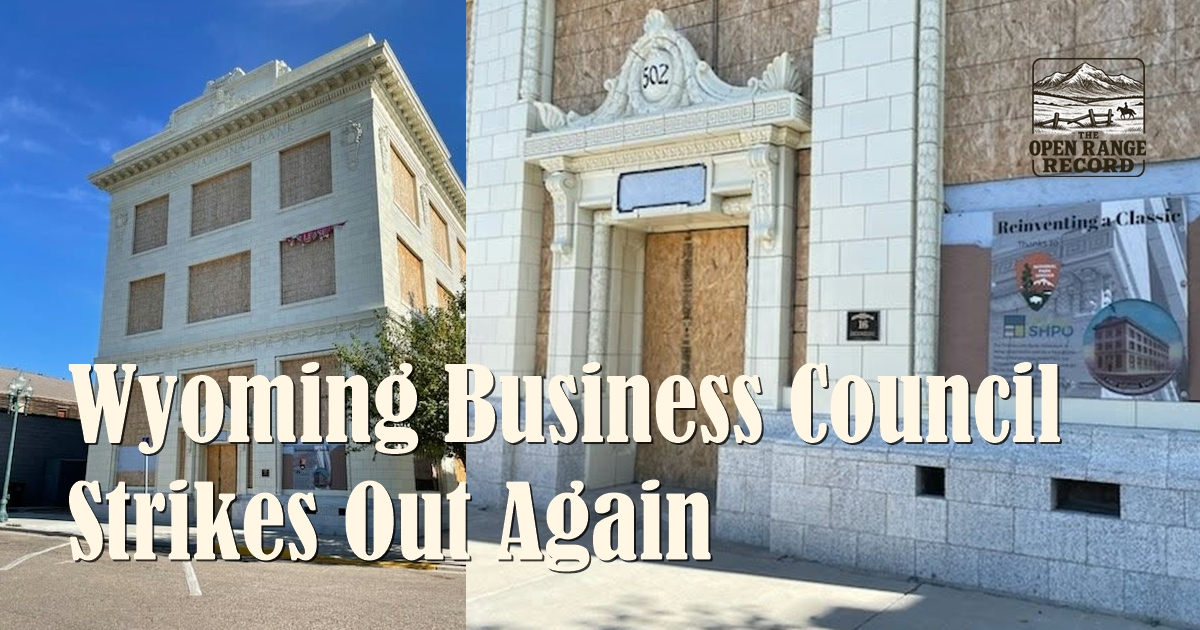
ROCK SPRINGS — Through a Wyoming Business Council program, the state approved a $2,917,701 grant to help the City of Rock Springs rehabilitate a vacant historic bank building that private developers had not taken on. The grant-funded work stabilized the property, but the city never finished turning it into the downtown commercial space it envisioned. This year, the city approved selling the building to a private developer for $75,000.
The city had a reason to take the project on. The 1917 First Security Bank building had sat empty for decades, and its deteriorating condition stood in the way of a new use. Wyoming Business Council funding offered a way to tackle the costly foundation, structural, and safety work that kept private investors away.
The public investment did not bring the building back into use while the city owned it. More money was needed to finish the redevelopment, and the city decided to sell. What did taxpayers receive for that investment, and why did the city conclude that a $75,000 private sale was its best way out?
What the public was promised
The city sought the Wyoming Business Council grant in 2019 to preserve the 1917 building at 502 South Main Street and return it to productive use. Its application described a downtown anchor that could house a restaurant, offices, or small businesses. The $2,917,701 grant for the first phase was accompanied by a local match of $250,000 in cash and $74,189 in kind.
It was an appealing idea. A vacant historic building was deteriorating in the middle of Rock Springs, and restoring it would be expensive. The Wyoming Business Council says the public money paid for difficult structural and safety work, including access to the foundation and an elevator shaft. Work began in 2020, when pandemic-era cost increases also complicated the project.
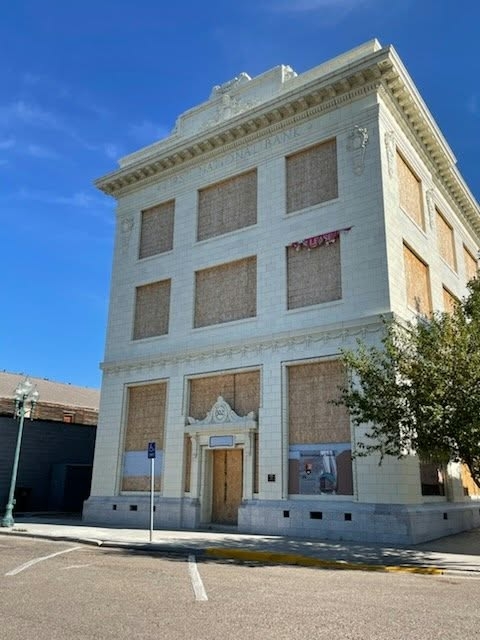
The Wyoming Business Council argues that the grant made a building the private market would not tackle safe and ready for a new use. Stabilization is a public benefit, though the building remained vacant. The state and city still need to account for the cost of the work, the remaining cost to finish it, and the value the public recovered in the sale.
The city did not complete the broader redevelopment it once envisioned. Officials later pointed to the money still needed to make the building usable and the ongoing burden of keeping it. Mayor Max Mickelson told the Wyoming Business Council that keeping more of the sale proceeds could help Rock Springs purchase a smaller building for downtown revitalization. The city took on the hardest early work with state help, yet still could not deliver the occupied building it had proposed.
From a public project to a private sale
The proposed $75,000 sale to developer Kody Watts stirred debate at City Hall. Council members tabled the offer in the spring, and the city also pursued a listing at a higher price. On August 4, the council approved a commercial real estate agreement with Watts.
Under that agreement, Watts was to begin rehabilitation within 12 months after closing and reach substantial completion within four years. The sale was described as cash and as is. The city also had an earlier obligation to pay $55,000 connected to the adjoining property acquired for the project. That expense, along with transaction costs and any state recapture, makes the city's eventual net proceeds smaller than the headline sale price.
The sale terms offer a path to getting the building occupied. They also place the improved property in private hands for a fraction of the public grant. The grant money was spent on rehabilitation, so subtracting $75,000 from $2.9 million is not a full accounting of the public benefit or cost. It does show why taxpayers deserve a clear accounting of what was built, what remains to be done, and what value the public recovered.
The vote that needs a final answer

The grant originally required the state to recapture 90 percent of sale proceeds, up to the grant amount. At the Wyoming Business Council's February 2026 meeting, staff presented Rock Springs' request to lower that rate to 25 percent. Staff described 90 percent as unusually high compared with other projects. Bruce Pivic of Rock Springs, a member of the Wyoming Business Council Board of Directors, moved to recommend the change, and the board voted unanimously in favor.
At 90 percent, the state's share of a $75,000 sale would be $67,500. At 25 percent, it would be $18,750. Those figures are calculations based on the sale price, not confirmed payments. The recapture provision concerned sale proceeds; it did not promise repayment of the entire grant.
Pivic's role is significant because, as a Wyoming Business Council board member from Rock Springs, he voted on the city's request. The recorded vote does not show that he had a personal financial interest in the sale. It does show exactly where he stood on how much of the proceeds should return to the state.
The Wyoming Business Council's recommendation was not itself a final amendment of terms set by the State Loan and Investment Board. The Wyoming Business Council's own public explanation of the project still describes the recapture rate as 90 percent. Until the SLIB decision and any signed amendment are produced, The Open Range Record cannot say which rate governed the closing or how much the state received.
Rock Springs' original vision and the eventual sale leave a larger question: When the state pays millions to make a difficult property usable, what protections ensure that the public shares in the benefit if the building later passes to a private owner?
The Open Range Record raised a similar question in its earlier reporting on the publicly supported Melvin Brewing property in Alpine. The arrangements differ, and each deserves to be judged on its own agreements and outcomes. In both cases, public money helped create or improve an asset that private parties could use. The public deserves to see the entire financial path, from grant award through the final disposition of the property.
For the First Security Bank building, that means the final SLIB action, the closing statement, the city's net proceeds, and a record of what Watts does with the property. Until those documents are in hand, the strongest conclusion is also the simplest: taxpayers paid heavily to rescue a historic building, the city sold it for $75,000, and the state has not yet shown the public a complete accounting of what came back.