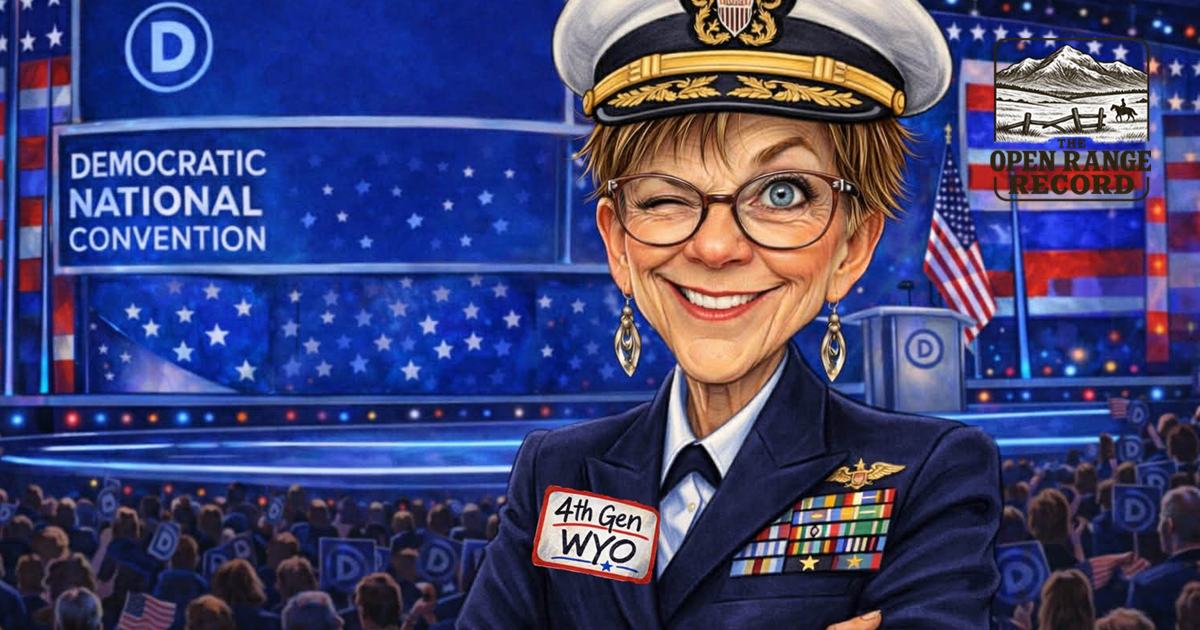
Gail Symons
wants you to believe she is a conservative. She tells everyone who will listen
that she’s a fourth-generation Wyoming citizen and a former naval officer; a
civics educator and a defender of institutions. That’s the image.
But if you read her columns carefully — not casually, not selectively, but
carefully — a pattern emerges. Patterns matter. Because when someone repeatedly
frames one side as dangerous, extreme, fear-driven, or disingenuous, that’s not
neutrality. That’s ideology.
The Hegseth Divide
The clearest
window into Symons’s worldview came during the recent controversy over
Secretary of Defense Pete Hegseth’s speech condemning race-based quotas and DEI
frameworks in the military. In Cowboy State Daily’s coverage, Symons reacted
strongly, calling Hegseth’s remarks a “betrayal” of service members and
dismissing his quota concerns outright:
“There never have been any quotas, that's bulls--- and it's a lie.”
She further characterized his message as suggesting that women and minorities
were merely “numbers to check a box.”¹
In the same article, a 29-year Army veteran and Green Beret offered a different
perspective. He argued that military focus had drifted toward “diversity of
skin color” rather than “diversity of thought,” and emphasized equal standards
over equal outcomes.
That contrast is not small; it is philosophical. One argument centers on merit,
uniform standards, and war-fighting effectiveness. The other centers on
perceived institutional insult and protection of identity-based advancement.
Those are not two shades of the same conservatism. They are two different
governing philosophies.
The Wyoming Republican Party platform is not subtle about its priorities. Under
“American Exceptionalism,” (No. 15) it calls for defending sovereignty from
foreign and domestic influences that would infringe on constitutional rights.
It speaks plainly about protecting legal residents and maintaining national
borders.
Under “Military,” (No. 16) it demands a strong national defense to protect our
people, our interests, and our way of life — and expresses unwavering support
for those who serve honorably.
Those planks are not bureaucratic in tone. They are not preservationists; nor
are they process-driven. They are assertive. They’re sovereignty-focused
and standards-based.
When military policy is debated through the lens of merit versus identity, it
is not unreasonable for Republican voters to expect arguments grounded in equal
standards and strength — not institutional insulation. That is the standard the
party has long adopted.
The Naval Academy Question
That same
article contains this paragraph:
“Symons attended the Navy Supply Corps School, formerly located in Athens,
Georgia, where she was among some of the first women to graduate from the Naval
Academy. That experience proved incredibly difficult for Symons and her roughly
20 female classmates due to the high expectations placed on them through
becoming a part of the previously all-male institution, she said.”
Navy Supply Corps School is not the United States Naval Academy. Yet the
sentence structure strongly implies Naval Academy graduation. That phrasing has
never been publicly clarified, nor has the article been corrected.
When credentials form part of a columnist’s authority — particularly in debates
over military policy — precision matters. If there is a misunderstanding,
a simple clarification would strengthen credibility. But if it’s not
corrected, silence allows the assumption to stand.
Precision matters in credentials and in language, and it should matter in
political labels, too.
Election Reform as Democracy Breaking
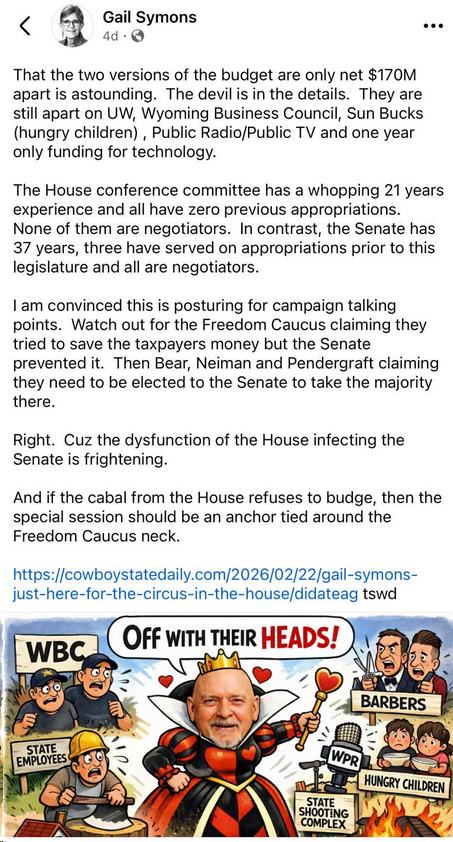
Symons has written repeatedly against voter ID tightening, drop box removal, residency
enforcement, and expanded audits. In one column, she warned: “When
lawmakers fix what is not broken, voters and clerks pay for it. That's how
democracy breaks; one unnecessary restriction at a time.”
She described reform proposals as creating a “manual, restrictive,
partisan-heavy framework”² and argued they “feed a storyline claiming Wyoming
elections lack integrity when audits prove otherwise.” In another
column, she accused Secretary of State Chuck Gray of “spreading distrust and
disinformation”³ and labeled fraud concerns the “bogeyman in the closet.”
Requiring identification to vote is not radical. Citizenship verification is
not authoritarian. Chain-of-custody scrutiny is not extremism.
Traditional conservatism has long held that secure systems strengthen trust — not weaken it. But in Symons’s framing, reform itself becomes suspect. Doubt becomes destabilizing. Oversight becomes fearmongering. That rhetorical posture aligns far more closely with institutional preservation than reform-minded conservatism.
Loyalty, Cronyism, and the “New GOP”
Symons has
also taken direct aim at the Freedom Caucus and state Republican leadership,
calling current party dynamics “laughable” and describing what she sees as
“institutionalized cronyism.” She portrays vacancy processes as
loyalty-driven and insiders protecting their own.
Whether one agrees with Freedom Caucus legislators or not, describing internal
party conflict as systemic corruption is not neutral commentary, it is
factional positioning. Hers consistently moves in one direction.
So What Is Conservative?
Again, there
is nothing wrong with disagreeing with the Freedom Caucus. As with any
political group, there’s plenty to criticize. There’s nothing wrong with
opposing voter ID expansion, defending DEI-era policy, or even believing
election systems are perfect as they are. But let’s call things what they are.
When you repeatedly frame election reformers as fearmongers, characterize
conservatives as cronyists, describe oversight efforts as “disinformation,” and
treat platform-aligned Republicans as destabilizing extremists, you are not
standing above the fray. You are in it.
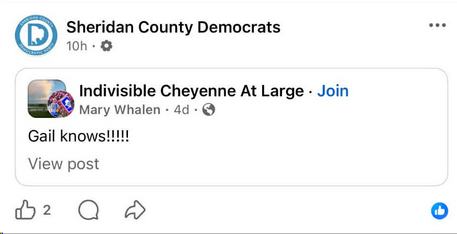
The Wyoming Republican Party has 23 planks in its platform. Many of them speak
directly to election integrity, limited government, decentralization of power,
and equal standards under the law. The Freedom Caucus did not invent those
planks. They were written, adopted, and voted on by delegates.
If a columnist consistently opposes the practical application of those planks,
that is a philosophical difference — not moderation. It is fair for voters to
ask whether the lens being used is truly conservative in the Wyoming sense of
the word, or something else entirely. Here’s the part that lands:
The legislators Symons criticizes most often are at least transparent. They
tell you exactly what they believe. They campaign on it. They take the heat for
it. They do not hide their alignment or soften their posture for comfort. Agree
or disagree with them — you know where they stand.
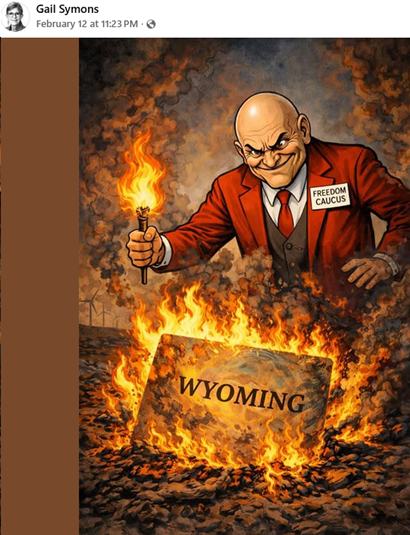
But when someone labels others as extreme, partisan, or disingenuous while
presenting themselves as the lone guardian of process and reason, the standard
must apply both directions. You cannot accuse others of ideological
rigidity while consistently advancing one side of every ideological fight.
You cannot call reform “dangerous” while dismissing skepticism as “bogeyman”
politics. And you cannot claim neutrality while writing from the same
side of the argument, over and over and over, again.
Wyoming voters are not naïve. They can read, and they can compare and see
patterns. So perhaps the real question is not whether Gail Symons is
conservative but rather if she even knows what that word means. She keeps
using it after all.
A larger question is whether Symons has been successful in convincing Wyoming
Republicans that her definition of conservatism—bigger government, DEI,
rejection of election integrity issues, more government spending and defense of
institutionalized Democrat policies—is actually what the word means. In the
end, this isn’t about personality, It’s about clarity.
If you are a reform skeptic, say so. If you believe institutions are
largely sound, say so. If you prioritize stability over structural tightening,
say so. Just own it.
But don’t brand yourself as the arbiter of conservative principle while
repeatedly opposing the very planks the party adopted. Wyoming deserves honest
labels.
Voters deserve to know exactly which side of the fence someone is standing on —
especially when they’re the one lecturing everyone else about how to move it.